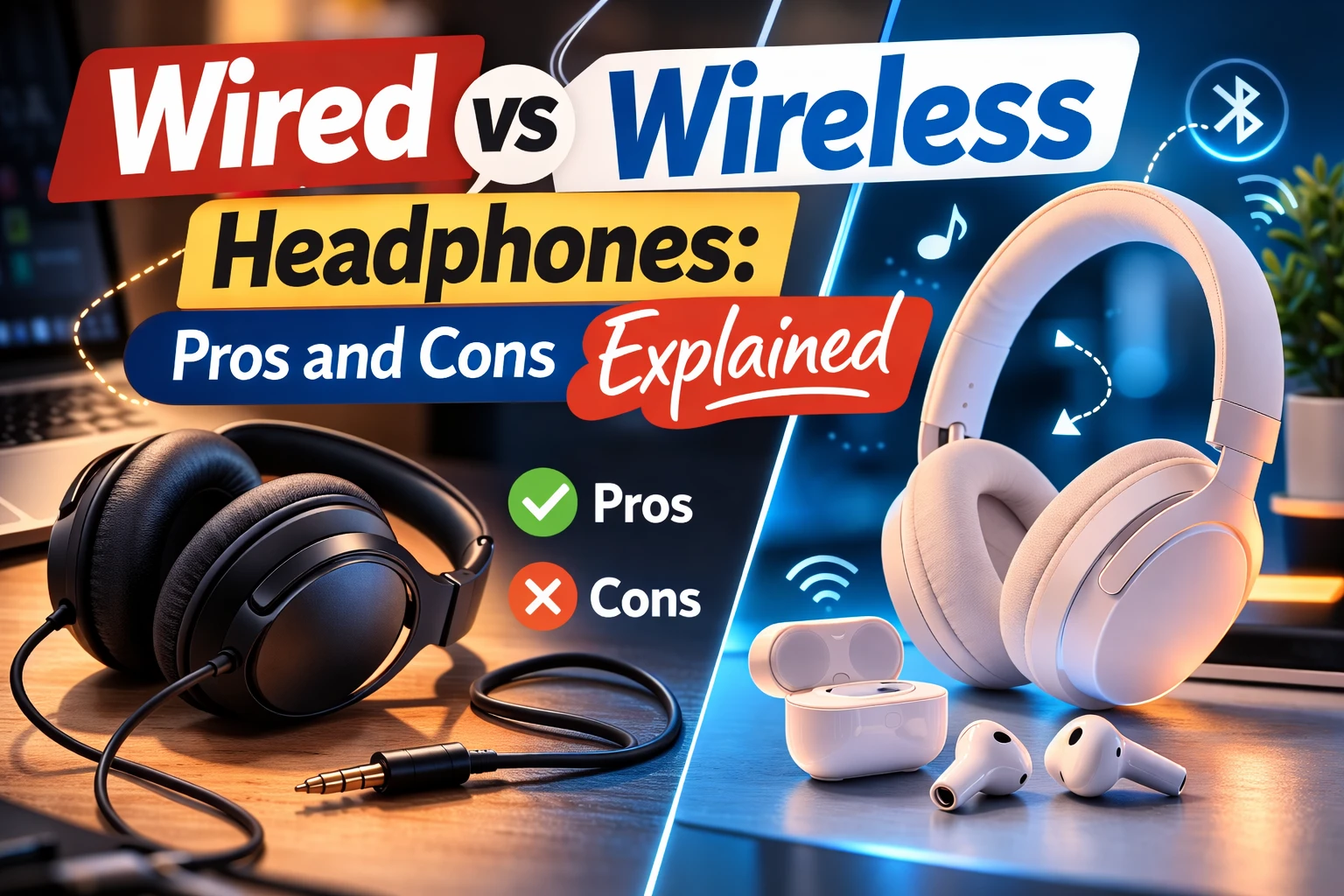
Headphones are no longer just a consumer gadget — they are a daily work tool. From remote meetings and focus sessions to commutes and client calls, the type of headphones professionals choose has a tangible effect on their productivity and audio experience. Yet despite rapid advances in Bluetooth technology, the choice between wired and wireless remains genuinely nuanced.
In 2026, both categories have matured significantly. Wireless headphones now offer low-latency connections and multi-device pairing, while wired options continue to hold ground in areas where signal reliability and audio fidelity are non-negotiable. This guide helps business professionals and audio beginners understand the real trade-offs — without hype or brand bias.
Whether you’re equipping a home office, sourcing gear for a team, or simply replacing a worn-out pair, understanding these differences will help you make a more informed decision. For a broader look at productivity hardware choices, see our guide on essential tools for the modern professional. (Internal Link)
How Wired and Wireless Headphones Work
Before comparing performance, it helps to understand the fundamental technology behind each type.
Wired Headphones
Wired headphones transmit audio through a physical cable — typically a 3.5mm analog jack or USB-C connection. The signal travels directly from the source device (laptop, phone, audio interface) to the headphone driver with no intermediate processing. This simplicity is both their strength and their limitation.
Wireless Headphones
Wireless headphones use Bluetooth — most commonly Bluetooth 5.2 or 5.3 in current models — to receive an audio signal from a paired device. The headphones contain a battery, a Bluetooth chip, a digital-to-analog converter (DAC), and an amplifier. Some higher-end models also include active noise cancellation (ANC) processors. All of this processing happens inside the headphone itself.
- Bluetooth codecs such as SBC, AAC, aptX, aptX HD, and LDAC determine audio quality and latency over wireless connections
- Battery life typically ranges from 20 to 40 hours depending on ANC usage
- Multipoint pairing allows connection to two devices simultaneously — a feature increasingly common in 2025–2026 models
- Latency has improved significantly; modern low-latency codecs bring wireless delay below 50ms in many cases
Wired vs. Wireless: Side-by-Side Comparison
| Feature | Wired Headphones | Wireless Headphones |
|---|---|---|
| Audio Quality | Lossless, no compression | Codec-dependent; LDAC/aptX HD approach lossless |
| Latency | Near zero | 20–200ms depending on codec and device |
| Battery Required | No | Yes (20–40 hrs typical) |
| Portability | Limited by cable | High — no cable constraint |
| Setup Complexity | Plug and play | Pairing required; occasional reconnection issues |
| Noise Cancellation | Passive only | Active + Passive available |
| Durability Risk | Cable wear over time | Battery degradation over 2–4 years |
| Price Range | Wide — entry to studio-grade | Wide — budget to premium |
| Compatibility | Universal (3.5mm or USB-C) | Requires Bluetooth; some codec limitations |
| Best For | Studio work, gaming, focused audio | Office mobility, commuting, calls |
Pros and Cons of Wired Headphones
Advantages
- Consistent audio quality: No data compression means the signal you hear matches what the source outputs — critical for audio editing, music production, or detailed listening.
- No charging interruptions: Wired headphones function as long as the source device has power. There is no mid-meeting battery cutoff.
- Zero pairing friction: Connecting is immediate. This matters in professional settings where time spent troubleshooting Bluetooth is time lost.
- Lower cost for comparable quality: At equivalent price points, wired headphones often deliver better driver components than their wireless counterparts, because there is no budget allocated to batteries or Bluetooth chips.
- No signal interference: Wired connections are not affected by crowded wireless environments such as conference halls or open-plan offices with many Bluetooth devices.
Disadvantages
- Physical constraint: The cable limits movement, which can be disruptive during presentations, collaborative work, or any scenario requiring mobility.
- Cable management: Cables tangle, fray at connectors, and require careful storage — a practical concern for daily commuters.
- Disappearing ports: Many modern laptops and smartphones have removed the 3.5mm jack, requiring adapters that add complexity and potential signal loss.
- No active noise cancellation: Passive isolation (via ear cup design) is the only option, which is less effective in dynamic noise environments.
Pros and Cons of Wireless Headphones
Advantages
- Freedom of movement: Operating within a 10–30 meter Bluetooth range, wireless headphones support walking, multitasking, and transitioning between rooms without interruption.
- Active Noise Cancellation (ANC): Higher-end models use microphones to sample ambient noise and generate counteracting frequencies in real time — particularly useful in open offices or during travel.
- Multipoint connectivity: Many 2025–2026 models connect to a laptop and phone simultaneously, automatically switching audio sources when a call comes in.
- Integrated features: Voice assistant access, on-ear controls, call microphones, and wear detection are built into many wireless models.
- No port dependency: Compatibility with any Bluetooth-enabled device avoids the adapter problem that affects modern wired users.
Disadvantages
- Battery lifecycle: Lithium-ion batteries degrade over time. After two to four years of regular use, battery life may drop noticeably, and replacement is often not user-serviceable.
- Latency in precision tasks: While much improved, wireless latency can still affect video editors or musicians monitoring audio in real time, depending on codec support.
- Environmental interference: Dense wireless environments can cause dropouts or audio artifacts, particularly with older Bluetooth versions.
- Higher complexity: Firmware updates, codec negotiation, and Bluetooth profiles add variables that wired connections simply do not have.
Real-World Use Cases by Professional Context
Remote Work and Video Conferencing
For professionals on frequent video calls, wireless headphones with built-in call microphones and multipoint pairing offer clear practical advantages. The ability to step away from a desk without disconnecting — to refill coffee or access a printer — reduces friction during long work-from-home days. ANC further improves call clarity in shared spaces.
However, if call quality is paramount and the work environment is quiet, a wired headset with a dedicated boom microphone will typically deliver more reliable voice transmission without Bluetooth-related compression.
Audio Production and Editing
Sound engineers, podcast producers, and video editors generally prefer wired headphones for monitoring work. The lossless signal chain and near-zero latency are necessary for accurate audio editing. Many professional-grade studio headphones do not offer wireless variants at all, as the market in that segment still prioritizes signal fidelity. (External Reference: SoundGuys – Wired vs. Wireless Headphones)
Commuting and Travel
Wireless headphones are the practical choice for commuters. Without cables to manage in crowded transit situations, and with ANC reducing engine and crowd noise, wireless over-ear headphones have become a standard commuter tool. Battery life of 30+ hours covers most multi-day travel scenarios without needing a charge mid-journey.
Open-Plan Office Environments
Open offices introduce both noise concerns and mobility demands. Wireless headphones with ANC address the noise issue; their freedom of movement supports informal collaboration. That said, teams with shared audio equipment or centralized conferencing systems may find wired setups more straightforward to manage at scale.
Decision Framework: Which Type Fits Your Situation?
Rather than recommending a single answer, the following framework maps common professional scenarios to the more suitable headphone type.
- You work in audio production or content creation → Wired. Signal fidelity and latency are non-negotiable in this workflow.
- You attend 4+ video calls per day and move around → Wireless. Multipoint pairing and ANC will reduce daily friction.
- You work in a loud, shared office → Wireless with ANC. Passive isolation alone is rarely sufficient in dynamic noise environments.
- You use a device without a headphone jack → Wireless or USB-C wired. Bluetooth eliminates the adapter dependency; USB-C wired is an alternative if audio quality matters.
- You need headphones for 8+ hours continuously → Wired. Battery anxiety and degradation over time are practical concerns for marathon work sessions.
- You’re on a budget and prioritize audio quality per dollar → Wired. The absence of wireless components means more of the cost goes toward drivers and build quality.
For teams evaluating hardware at scale, this decision is also influenced by IT compatibility, support overhead, and device fleet standards — factors worth assessing alongside individual preferences. Our overview of workplace productivity tools covers related hardware considerations. (Internal Link)
Key Specifications to Evaluate Before Buying
Regardless of which category you choose, the following technical specifications are worth reviewing before committing to a purchase. Independent testing data from sources such as RTINGS.com can help validate manufacturer claims with objective measurements. (External Reference)
For Wired Headphones
- Impedance (Ohms): Higher impedance headphones (150Ω+) require a dedicated amplifier; lower impedance (16–32Ω) works well with standard devices.
- Frequency response: A flatter response curve is preferred for reference listening; a boosted bass curve suits casual listening.
- Cable type and replaceability: Detachable cables extend the headphone’s usable lifespan significantly.
- Driver size: Larger drivers (40–50mm) generally move more air, though driver quality matters more than size alone.
For Wireless Headphones
- Bluetooth version and codec support: Confirm codec compatibility with your primary device. iPhone users are limited to SBC and AAC; Android devices may support aptX or LDAC.
- ANC effectiveness: Look for objective test data rather than marketing claims — ANC performance varies substantially between models.
- Charging time and standard: USB-C fast charging (some models offer 15 minutes for 3 hours of use) is a practical differentiator.
- Multipoint pairing support: Verify whether simultaneous connection to multiple devices is supported and how switching behavior is handled.
Summary
Wired and wireless headphones serve different professional needs, and neither category is universally superior. Wired headphones offer lossless audio, zero latency, and operational simplicity that makes them the preferred choice for audio-critical work and extended single-device use. Wireless headphones provide freedom of movement, active noise cancellation, and multi-device flexibility that suits mobile professionals and open office environments.
The most practical approach is to assess your primary use case — not the feature list of any specific product. For most business users who attend regular calls and work in variable noise conditions, a wireless headphone with ANC and multipoint pairing will cover daily needs well. For those in audio production or who prioritize uncompromised signal quality, wired remains the more reliable path.
As Bluetooth technology continues to mature, the gap between the two categories will narrow further — but the fundamental trade-off between signal simplicity and wireless convenience is unlikely to disappear entirely.
Next read: How to Build a Focused Remote Work Setup in 2026 (Internal Link)
Frequently Asked Questions
1. Are wired headphones always better for audio quality than wireless?
In most consumer use cases, the difference is not perceptible without trained listening or reference equipment. However, at the professional and audiophile level, wired headphones using a lossless signal chain do maintain a measurable quality advantage over compressed Bluetooth audio, unless high-resolution codecs such as LDAC are supported by both the source and headphones.
2. Can wireless headphones cause latency issues during video calls?
Modern wireless headphones using Bluetooth 5.0 or later, combined with low-latency codecs, generally perform acceptably for video conferencing. Noticeable audio-video sync issues are uncommon in call scenarios. Latency becomes a more significant concern when monitoring audio during recording or editing.
3. How long do wireless headphone batteries typically last before degrading?
Lithium-ion batteries in wireless headphones typically retain around 80% of their original capacity after 300–500 full charge cycles. For daily users charging every one to two days, this can translate to two to four years before a meaningful drop in battery life is noticed.
4. Do I need a headphone jack to use wired headphones with a modern laptop?
Not necessarily. Many wired headphones are available with USB-C connectors, which are standard on most current laptops and an increasing number of smartphones. Alternatively, a 3.5mm to USB-C adapter can be used, though audio quality through an adapter depends on the adapter’s built-in DAC quality.
5. Is active noise cancellation safe for long-term use?
ANC itself does not generate harmful sound pressure levels. However, ANC can sometimes create a mild pressure sensation in the ears for some users, which is a result of phase-canceling frequencies rather than sound volume. If this sensation is uncomfortable, transparency or passthrough modes — available on many current models — allow ambient sound back in without removing the headphones.