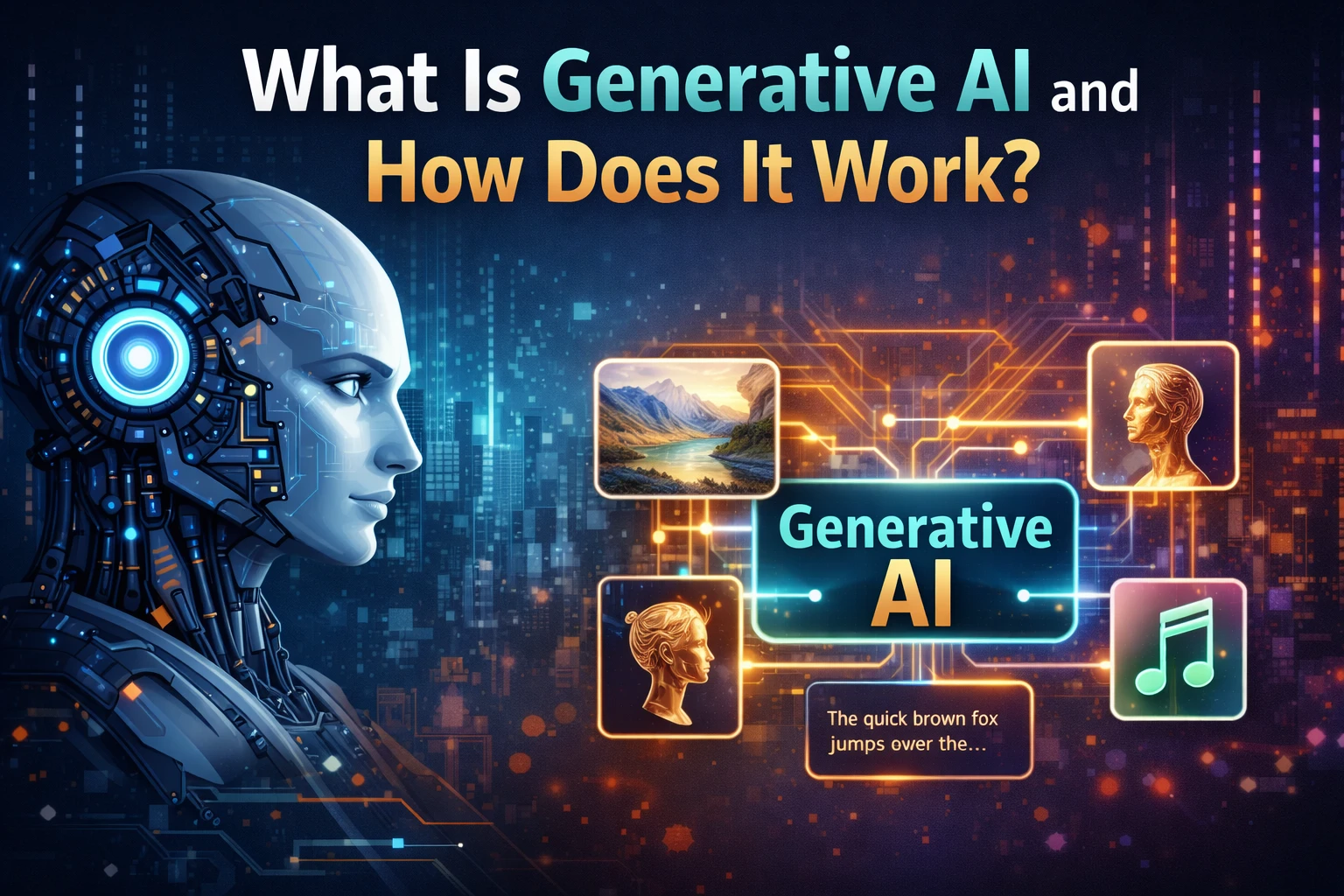
Introduction: Why Generative AI Matters in 2026
Artificial intelligence is no longer a concept reserved for research papers and enterprise software budgets. In 2026, generative AI tools have become part of everyday workflows — from drafting emails and summarizing reports to generating code and producing images.
Yet despite widespread adoption, many professionals still lack a clear understanding of what generative AI actually is, how it works under the hood, and what distinguishes it from other forms of AI. That knowledge gap leads to poor tool selection, unrealistic expectations, and missed opportunities.
This guide is written for business professionals, team leads, and curious beginners who want a practical, honest explanation of generative AI — without the marketing noise. Whether you are evaluating tools for your organization or simply trying to understand what is driving this wave of technology, this article will give you a structured foundation.
Related reading: A Beginner’s Guide to AI Tools for Business (Internal Link)
What Is Generative AI?
Generative AI refers to a class of machine learning models that are trained to produce new content — text, images, audio, video, or code — based on patterns learned from large datasets. Unlike traditional AI systems that classify or predict from a fixed set of outputs, generative models create novel outputs that did not exist in their training data.
The key distinction is in the word generative: these systems do not retrieve or copy content. They generate it based on statistical relationships learned during training.
How It Differs from Traditional AI
Traditional AI systems are largely rule-based or discriminative. A spam filter classifies emails as spam or not spam. A fraud detection model flags transactions that match known patterns. These systems take input and map it to a predefined category or value.
Generative AI works differently. It learns the underlying structure of data and can produce new samples that match that structure. A language model trained on billions of documents learns grammar, reasoning patterns, and factual associations — and can then generate coherent, contextually appropriate text.
Key differences at a glance:
- Traditional AI classifies or predicts from existing categories
- Generative AI produces new content from learned patterns
- Traditional models require labeled training data for each task
- Generative models can perform multiple tasks from a single training run
- Traditional models are narrow in scope; generative models are general-purpose
How Generative AI Works
Understanding the mechanics behind generative AI requires a basic familiarity with neural networks and training processes. The explanation below is simplified but accurate enough to support practical decision-making.
The Training Process
Generative AI models are built through a process called training, in which a neural network is exposed to massive amounts of data. During training, the model adjusts billions of internal parameters — numerical values that determine how it processes and generates information — to minimize the difference between its outputs and what it observes in the training data.
For large language models (LLMs), training involves predicting the next token (word or word fragment) in a sequence. Over billions of examples, the model learns grammar, factual knowledge, reasoning structures, and stylistic patterns.
For image generation models, training often involves learning to map text descriptions to visual representations, using techniques such as diffusion or variational encoding.
Inference — How the Model Responds to You
Once trained, the model enters inference mode: it receives an input (called a prompt) and generates an output based on the patterns it has learned. The model does not “look up” answers. It calculates the most statistically probable continuation of your input, given everything it learned during training.
This is why prompt design matters. A well-structured prompt narrows the probability space and guides the model toward more relevant outputs. A vague prompt produces vague output.
Key Architectural Components
Most modern generative AI models share a common foundation:
- Transformer architecture: Enables models to weigh the relevance of different parts of an input when generating each word or token
- Attention mechanism: Allows the model to focus on contextually important elements across long sequences
- Embeddings: Convert words or image patches into numerical representations the model can process
- Fine-tuning and RLHF: Post-training alignment processes that adjust the model’s behavior to be more helpful, accurate, and safe
(External Reference: Attention Is All You Need — Original Transformer Paper)
Types of Generative AI Models
Not all generative AI systems work the same way or serve the same purpose. Below is a comparison of the major model types currently in use.
| Model Type | Primary Output | Common Use Cases | Example Applications |
|---|---|---|---|
| Large Language Models (LLMs) | Text | Writing, coding, Q&A, summarization | ChatGPT, Claude, Gemini |
| Diffusion Models | Images | Art generation, design, product mockups | Midjourney, DALL·E, Stable Diffusion |
| Code Generation Models | Code | Autocomplete, debugging, documentation | GitHub Copilot, Cursor |
| Audio Models | Voice, music | Voiceover, audio editing, transcription | ElevenLabs, Whisper |
| Multimodal Models | Mixed (text + image + audio) | Complex workflows, visual Q&A | GPT-4o, Gemini 1.5 |
| Video Generation Models | Video clips | Marketing, prototyping, storytelling | Sora, Runway, Pika |
Each type has distinct strengths, limitations, and appropriate use contexts. Organizations evaluating generative AI should align tool selection with specific workflow needs rather than adopting tools based on general popularity.
Real-World Use Cases in Business
Generative AI is being applied across industries in ways that reduce repetitive work, accelerate production cycles, and support decision-making. The following examples reflect documented use cases rather than projections.
Content and Communication
Marketing teams use language models to draft product descriptions, social media posts, internal reports, and customer emails. Legal and compliance teams use them to summarize long documents and generate first-draft contracts for human review.
Common applications in this category:
- Drafting and editing long-form written content
- Translating documents across languages at scale
- Summarizing meeting transcripts and research papers
- Generating structured data from unstructured input (e.g., extracting key fields from invoices)
Software Development
Developers use code generation tools to auto-complete functions, refactor legacy code, write unit tests, and generate documentation. These tools do not replace developers but reduce the time spent on boilerplate and low-complexity tasks.
Customer Support and Operations
Businesses deploy generative AI in customer-facing roles — chatbots, FAQ systems, and support ticket triage — to reduce response times. Internally, operations teams use it to analyze large datasets and generate structured summaries for decision-makers.
Related reading: How AI Is Changing Customer Support Workflows (Internal Link)
(External Reference: McKinsey Global Institute — The Economic Potential of Generative AI)
Limitations and Risks to Consider
A balanced assessment of generative AI requires an honest examination of its current limitations. These are not theoretical concerns — they are operational realities that affect every organization adopting these tools.
Accuracy and Hallucination
Generative AI models can produce confident-sounding outputs that are factually incorrect. This is known as hallucination. Because these models generate statistically probable text rather than verifying facts against a reliable source, they can fabricate statistics, misattribute quotes, and describe events that did not occur.
Any deployment that requires factual accuracy — legal, medical, financial, or journalistic — must include human review as a mandatory step.
Data Privacy and Security
When employees use generative AI tools with proprietary or sensitive business data, there is a risk that this data is used to improve the model or accessed by third parties, depending on the provider’s terms of service. Organizations should review data handling policies before integrating any external AI tool into workflows that involve confidential information.
Bias and Representation
Generative models reflect the biases present in their training data. This can manifest as systematic errors in language, visual representation, or decision-support outputs that disproportionately affect certain groups. Bias auditing and diverse review processes are important when deploying AI in customer-facing or hiring-related contexts.
Summary of key limitations:
- Hallucination and factual inaccuracy without grounding mechanisms
- Inconsistent output quality across prompts and use cases
- Data privacy risks depending on deployment architecture
- Embedded bias from training data
- Limited reasoning over complex multi-step problems without additional tooling
- High computational cost at scale
A Decision Framework for Evaluating Generative AI Tools
Before selecting a generative AI tool for a business workflow, consider the following structured approach.
Step 1 — Define the Task Type
Determine whether your use case is primarily about text, code, image, or multimodal output. This narrows the relevant model category immediately.
Step 2 — Assess Accuracy Requirements
If the output will be reviewed by a human before use, a wider range of tools is acceptable. If the output is automated and customer-facing, accuracy and consistency requirements are significantly higher.
Step 3 — Evaluate Data Sensitivity
Consider whether the input data is public, internal, or regulated. Tools with enterprise data handling agreements and on-premise deployment options are more appropriate for sensitive workflows.
Step 4 — Pilot Before Committing
Run structured pilots with representative prompts before committing to a tool or integrating it into production workflows. Evaluate consistency, output quality, latency, and cost per use case — not just general capability.
Step 5 — Plan for Human Oversight
Define where human review is required and build that into the workflow design. Generative AI is most effective as an acceleration layer, not as a replacement for expert judgment.
Frequently Asked Questions
Q1: Is generative AI the same as artificial general intelligence (AGI)? No. Generative AI refers to a specific class of models that produce content based on patterns learned from training data. AGI refers to a hypothetical system capable of performing any intellectual task a human can do. Current generative AI systems, while powerful, are narrowly specialized tools — not general-purpose reasoning systems.
Q2: Do generative AI models “understand” what they are generating? Not in the human sense. These models generate outputs based on statistical relationships between tokens in their training data. They do not have beliefs, intentions, or awareness. This distinction matters when assessing reliability, especially in high-stakes domains.
Q3: Can generative AI be used safely with confidential business data? It depends on the deployment model. Browser-based consumer tools typically transmit data to external servers. Enterprise deployments with private cloud or on-premise configurations offer stronger data controls. Always review provider data policies before use.
Q4: How does prompt engineering affect output quality? Significantly. The clarity, structure, and specificity of a prompt directly influence the quality of the model’s output. Techniques such as providing examples (few-shot prompting), specifying output format, and breaking complex tasks into steps can substantially improve results.
Q5: What is the difference between a foundation model and a fine-tuned model? A foundation model is a large, general-purpose model trained on broad datasets. A fine-tuned model is a foundation model that has been further trained on domain-specific data to improve performance in a particular area — such as legal document analysis or medical summarization. Fine-tuned models generally outperform general models in specialized tasks.
Summary
Generative AI is a category of machine learning models designed to produce new content — text, images, code, audio, and more — by learning patterns from large datasets. Unlike traditional AI that classifies or predicts, generative models create novel outputs through a training and inference process built on transformer architectures.
In business contexts, these tools offer genuine productivity gains in content creation, software development, customer operations, and data processing. However, they come with documented limitations — including hallucination, data privacy considerations, and embedded bias — that require careful workflow design and ongoing human oversight.
For organizations evaluating generative AI, the priority should be matching the tool type to the specific task, assessing accuracy and data sensitivity requirements, and building human review into the workflow before scaling.
Next: What to read next How to Choose the Right AI Writing Tool for Your Business (Internal Link)