Introduction: Why Machine Learning Understanding Matters in 2026
Machine learning is no longer a concept confined to research labs or enterprise data teams. In 2026, it is embedded in tools that professionals use daily — from email spam filters and document summarizers to fraud detection systems and customer segmentation platforms.
Yet most people interacting with these tools have only a surface-level understanding of what is actually happening beneath the interface. This gap matters. When professionals and business owners lack foundational knowledge of how machine learning operates, they tend to either overestimate its capabilities or dismiss its limitations — both of which lead to poor decisions.
This guide explains how machine learning works in practical, accessible terms. It is designed for:
- Business professionals evaluating AI-powered SaaS tools
- Beginners who want a technically honest foundation without deep mathematics
- Managers and decision-makers integrating ML systems into workflows
No prior data science background is required.
What Is Machine Learning, and How Is It Different from Traditional Software?
The Core Distinction
Traditional software operates on explicitly written rules. A developer defines the logic: if this condition is true, then do that action. The program follows instructions precisely.
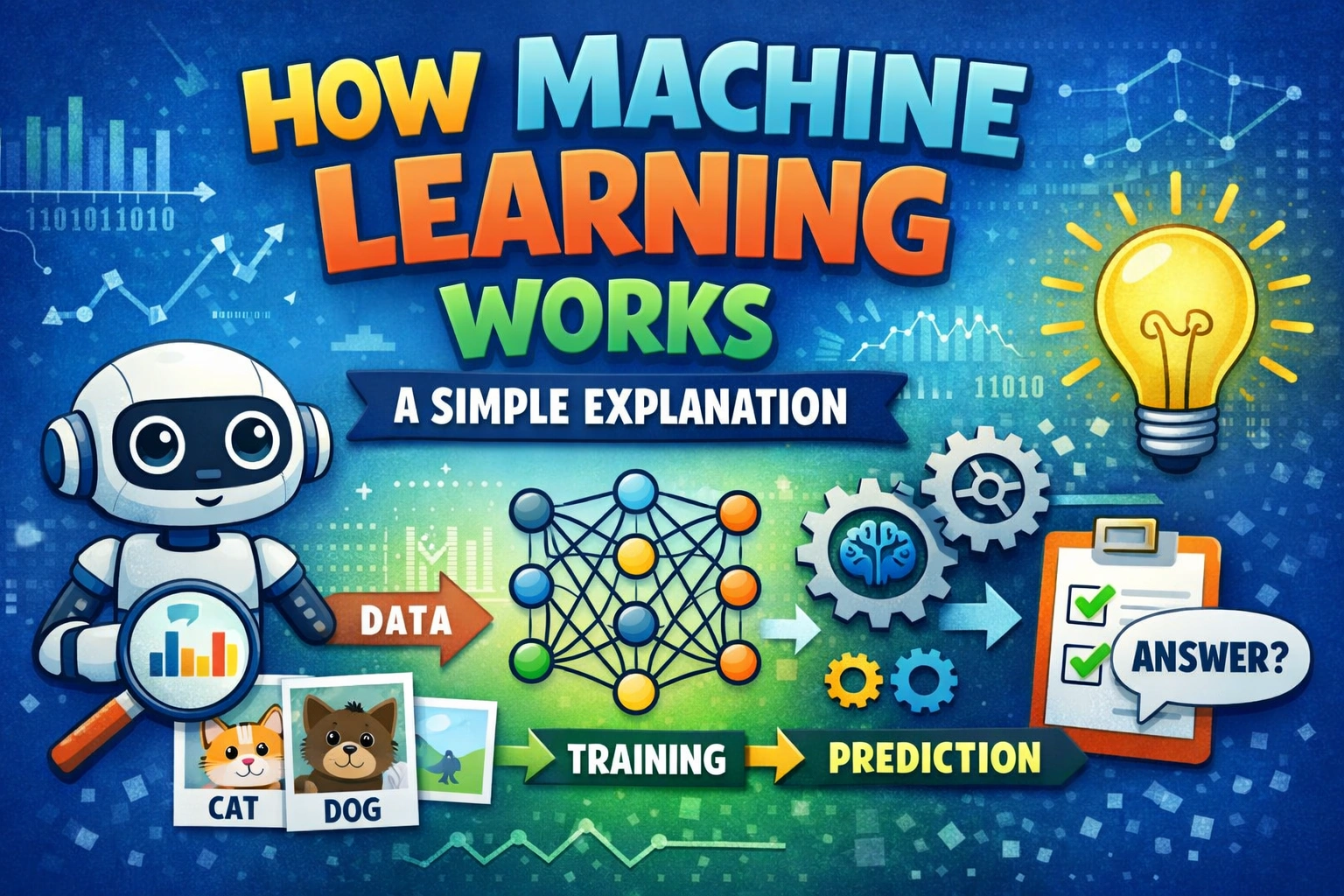
Machine learning takes a different approach. Instead of programming rules manually, a machine learning system is given data and tasked with identifying patterns on its own. The system adjusts its internal parameters — often called a “model” — until it can make accurate predictions or decisions based on new, unseen inputs.
This distinction has significant practical implications:
- Traditional software is predictable and auditable
- Machine learning models can generalize beyond their training data, but their reasoning is often opaque
- ML systems improve with more data; traditional software does not change unless a developer modifies it
A Practical Example
Consider an email inbox. A rule-based spam filter might block any message containing the word “lottery.” A machine learning spam filter, trained on thousands of labeled emails, learns complex patterns — sender history, unusual link structures, writing style — that no single rule could capture effectively.
The Three Core Types of Machine Learning
Understanding the categories of machine learning helps clarify which tools use which approach and why.
Supervised Learning
The model is trained on labeled data — input-output pairs where the correct answer is already known. The system learns to predict the output for new inputs.
Common use cases:
- Email classification (spam vs. not spam)
- Credit risk scoring
- Medical image diagnosis support
- Sales forecasting
Unsupervised Learning
The model is given data without labels and must find structure on its own. It identifies clusters, patterns, or anomalies without being told what to look for.
Common use cases:
- Customer segmentation
- Anomaly detection in financial transactions
- Topic modeling in document collections
- Recommendation groupings
Reinforcement Learning
An agent learns by interacting with an environment, receiving rewards for correct actions and penalties for incorrect ones. Over time, it develops a strategy to maximize cumulative reward.
Common use cases:
- Game-playing systems
- Autonomous systems and robotics
- Dynamic pricing optimization
- Ad bidding algorithms
How a Machine Learning Model Is Built: The Core Process
Step 1 — Data Collection and Preparation
All machine learning begins with data. The quality, quantity, and representativeness of training data directly determine model performance. Poorly labeled or biased datasets produce unreliable models regardless of algorithm sophistication.
Key data preparation steps include:
- Removing duplicate or irrelevant records
- Handling missing values
- Normalizing numerical ranges
- Encoding categorical variables
- Splitting data into training, validation, and test sets
Step 2 — Choosing an Algorithm
Different problem types call for different algorithms. A few widely used examples:
| Algorithm | Type | Typical Use Case |
|---|---|---|
| Linear Regression | Supervised | Predicting numerical values (e.g., revenue) |
| Decision Tree | Supervised | Classification, rule-based decisions |
| K-Means Clustering | Unsupervised | Grouping similar customers |
| Random Forest | Supervised | High-accuracy classification tasks |
| Neural Network | Supervised/Unsupervised | Image recognition, language modeling |
| Support Vector Machine | Supervised | Binary classification problems |
Step 3 — Training the Model
During training, the algorithm processes the training dataset repeatedly, adjusting internal parameters to minimize prediction error. This process is measured using a “loss function” — a mathematical measure of how wrong the model’s current predictions are.
The model iterates through the data in cycles (called epochs), gradually improving accuracy.
Step 4 — Evaluation
After training, the model is tested against data it has never seen — the test set. Common evaluation metrics include:
- Accuracy — percentage of correct predictions
- Precision and Recall — relevant for imbalanced datasets
- F1 Score — balance between precision and recall
- Mean Absolute Error — used in regression problems
Step 5 — Deployment and Monitoring
A deployed model is integrated into a product, service, or workflow. Importantly, model performance can degrade over time as real-world data shifts — a phenomenon called model drift. Regular monitoring and retraining are standard operational requirements.
Key Concepts That Come Up in Business Contexts
Overfitting and Underfitting
Overfitting occurs when a model learns the training data too precisely, including its noise and anomalies, and fails to generalize to new data. Think of a student who memorizes exam answers without understanding the underlying concepts.
Underfitting occurs when a model is too simple to capture meaningful patterns. It performs poorly on both training and new data.
Balancing the two is one of the central challenges in machine learning practice.
Feature Engineering
Features are the input variables the model uses to make predictions. Selecting and transforming the right features significantly affects model performance. A model predicting customer churn might use features such as login frequency, support ticket volume, and contract duration — all derived from raw data.
Bias in Machine Learning
ML models can reproduce or amplify biases present in training data. If a hiring algorithm is trained on historical data reflecting past discriminatory practices, it may replicate those patterns. This is a recognized challenge in enterprise AI deployment, with regulatory attention increasing globally.
Machine Learning in SaaS and Business Productivity Tools
Most business-facing AI tools are built on one or more machine learning components, even when this is not explicitly stated.
Common ML-powered features in SaaS tools:
- Natural language processing (NLP): Summarization, sentiment analysis, document classification
- Predictive analytics: Forecasting, churn prediction, demand planning
- Personalization engines: Content recommendations, adaptive interfaces
- Anomaly detection: Expense flagging, security alerts, quality control
- Computer vision: Invoice scanning, ID verification, product inspection
Understanding which ML category underlies a given feature helps professionals ask better questions during vendor evaluations — such as what data the model was trained on, how frequently it is retrained, and how performance is measured.
(Internal Link: How to Evaluate AI Features in SaaS Tools)
A Decision Framework: When Does Machine Learning Add Value?
Not every business problem benefits from machine learning. The following framework helps assess fit:
ML is likely well-suited when:
- The task involves recognizing patterns across large volumes of data
- The rules governing the task are too complex or numerous to write manually
- Historical labeled data is available or can be created
- The cost of occasional errors is acceptable given the volume of decisions
ML may not be the right fit when:
- Data volume is too small to train a reliable model
- The decision requires explainability and auditability that a black-box model cannot provide
- Rules are simple, stable, and already performing well
- Real-time processing at very high accuracy thresholds is required with no tolerance for error
This framework is not exhaustive, but it provides a starting point for evaluation discussions with technical teams or vendors.
Pros and Cons: A Balanced View
Advantages of Machine Learning
- Scales to handle data volumes no human team could process manually
- Identifies non-obvious patterns across complex, high-dimensional datasets
- Can continuously improve as more data becomes available
- Enables automation of judgment-based tasks across many domains
Limitations and Risks
- Requires significant, high-quality data to perform well
- Models can be difficult to interpret or audit
- Performance degrades if input data changes significantly over time
- Introduces risk of encoded bias from historical training data
- Ongoing infrastructure and monitoring costs are often underestimated
Frequently Asked Questions
1. Is machine learning the same as artificial intelligence? Machine learning is a subset of artificial intelligence. AI refers broadly to systems that perform tasks typically requiring human intelligence. Machine learning specifically refers to systems that learn from data. Not all AI systems use machine learning — some use rule-based logic.
2. How much data does a machine learning model need? There is no fixed answer. It depends on the complexity of the problem, the algorithm used, and the quality of the data. Some models perform well with thousands of examples; others require millions. Data quality typically matters more than raw volume.
3. Can small businesses benefit from machine learning? Yes, particularly through SaaS products that embed ML capabilities without requiring any internal data science expertise. Tools for customer segmentation, demand forecasting, and support automation are accessible at various price tiers.
4. How long does it take to build and deploy a machine learning model? For production-grade systems, timelines typically range from several weeks to several months, depending on data readiness, team capacity, and integration complexity. Off-the-shelf ML APIs and AutoML platforms can reduce this significantly.
5. What is the difference between machine learning and deep learning? Deep learning is a specialized type of machine learning that uses neural networks with many layers. It excels at tasks involving unstructured data — images, audio, and text — but requires substantially more data and compute resources than traditional ML methods.
Summary
Machine learning is a method of building software systems that learn from data rather than following explicitly programmed rules. It operates through a structured process: data collection, algorithm selection, model training, evaluation, and deployment.
The three primary types — supervised, unsupervised, and reinforcement learning — serve different problem categories. Business professionals interacting with AI-powered tools benefit from understanding which type is in use and what limitations apply.
Machine learning adds genuine value in data-rich, pattern-heavy contexts. It introduces real risks when data quality is poor, when bias is unaddressed, or when explainability is required but unavailable.
Building foundational knowledge of these mechanics allows professionals to evaluate tools more critically, ask better questions of vendors, and set realistic expectations for what automated systems can and cannot do.
Next Topic: How to Evaluate AI Features in SaaS Tools Before Buying (Internal Link)