Introduction: AI Is Already Part of Your Day
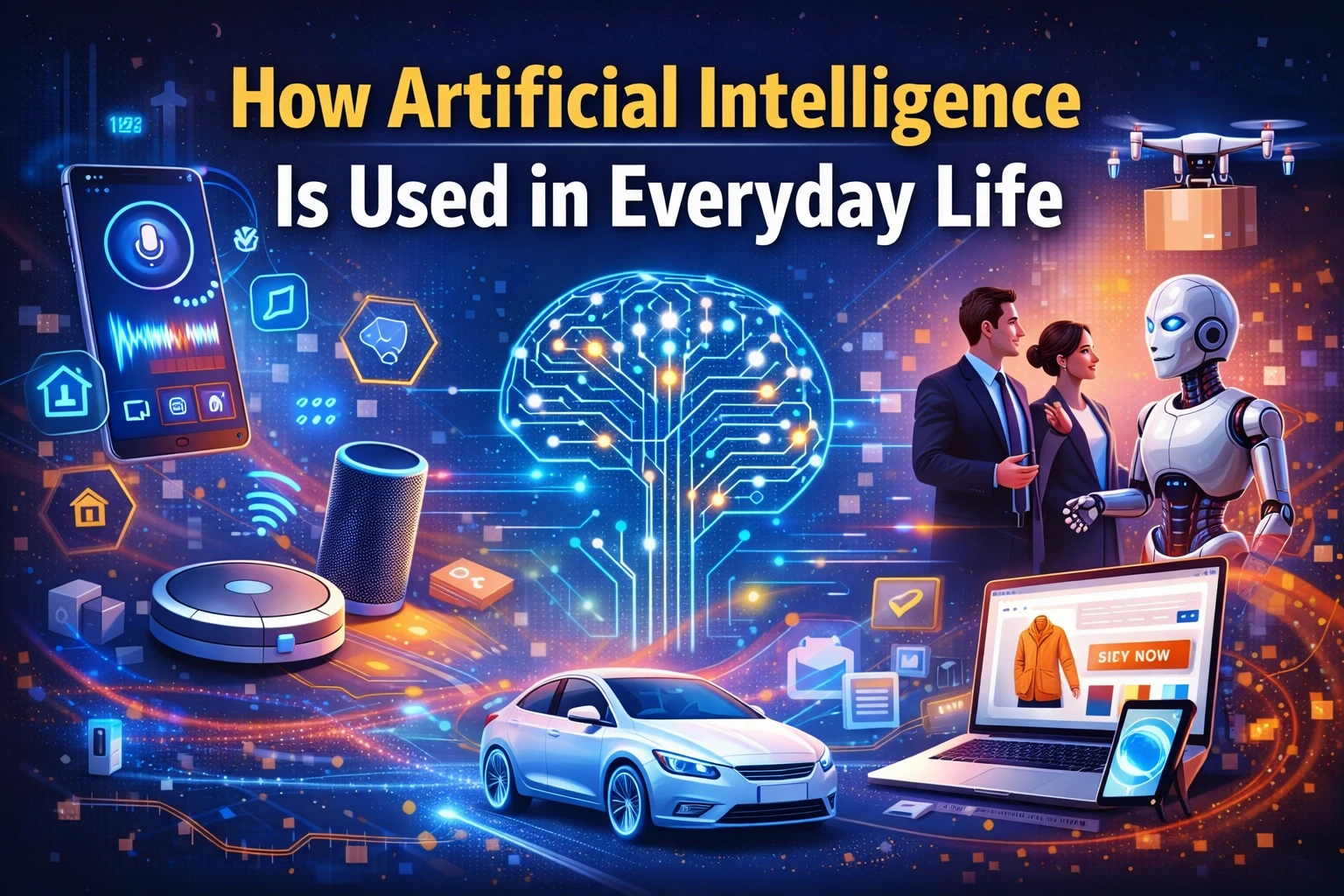
Most people picture artificial intelligence as something futuristic — autonomous robots, self-driving cars, or a voice that answers trivia questions. In reality, AI is already woven into the fabric of daily life, often in ways that go unnoticed.
By 2026, AI-powered systems influence how people receive news, navigate traffic, manage health conditions, and make purchasing decisions. The technology has moved well beyond research labs and into the hands of consumers, small business owners, and enterprise teams alike.
This guide is written for two audiences:
- Business professionals looking to understand how AI tools affect productivity, decision-making, and competitive positioning
- Beginners who are curious about AI but want plain-language explanations without technical jargon
The goal here is not to sell you on AI. It is to give you an accurate, grounded picture of where it is already operating in everyday contexts — and what that means for how you work and live.
(Internal Link: What Is Machine Learning? A Beginner’s Guide)
Understanding Why This Topic Matters in 2026
The Invisible Infrastructure Behind Daily Decisions
The challenge with explaining AI in everyday life is that it functions mostly in the background. When a streaming service recommends a show, an algorithm analyzed viewing patterns across millions of users to surface that suggestion. When a bank flags a suspicious transaction, a model trained on fraud behavior made that call — often in milliseconds.
This invisibility creates a knowledge gap. People benefit from AI without understanding its scope or limitations. That gap matters because:
- AI systems can carry biases from training data
- Automation is reshaping job roles across industries
- Personal data feeds the models that serve personalized experiences
Understanding AI’s role in daily life is no longer optional for professionals. It is foundational literacy.
(External Reference: Stanford AI Index Report – ai100.stanford.edu)
How AI Shows Up Across Daily Life
1. Communication and Information Access
Every day, billions of people interact with AI-driven systems when they search the web, read their email, or scroll through social feeds.
Search engines use natural language processing (NLP) to interpret queries beyond simple keyword matching. A search for “good places to eat near me that are open late” is understood contextually, not just literally.
Email clients apply AI to filter spam, prioritize important messages, and suggest short replies. These features operate silently unless a user explicitly looks for them.
Social media feeds are organized by recommendation algorithms that weigh engagement patterns, recency, and user behavior history. The sequence in which content appears is not chronological — it is AI-curated.
Key examples in this category:
- Smart spam filters in Gmail and Outlook
- Search intent recognition in Google and Bing
- Content ranking on LinkedIn, YouTube, and Instagram
2. Health and Personal Wellness
AI is making meaningful contributions to personal health management, particularly in wearables and diagnostic support tools.
Wearable devices such as smartwatches now use AI models to detect irregular heart rhythms, monitor sleep quality, and estimate recovery scores. These aren’t simple sensors — they apply pattern recognition on continuous biometric data.
Symptom checkers built into health apps use decision-tree logic and language models to help users assess symptoms before consulting a doctor. Their role is triage assistance, not diagnosis.
Mental health apps use conversational AI to provide structured journaling prompts, mood tracking, and cognitive behavioral therapy (CBT)-style guidance between professional sessions.
Key examples in this category:
- Apple Watch’s ECG and fall detection features
- Ada Health’s AI symptom assessment tool
- Woebot’s CBT-informed conversational interface
(External Reference: WHO Digital Health Overview – who.int/health-topics/digital-health)
3. Navigation and Transportation
Getting from point A to point B has been transformed by real-time AI systems.
Mapping applications like Google Maps and Waze analyze live traffic data, historical patterns, and incident reports to calculate optimal routes dynamically. A route suggested at 8:00 AM may be entirely different from one generated at 8:15 AM based on updated conditions.
Ride-hailing platforms use AI to match drivers with riders, predict surge pricing windows, and estimate arrival times with increasing accuracy.
Public transit systems in several major cities now use AI for predictive maintenance on trains and buses — identifying mechanical failures before they cause service disruptions.
Key examples in this category:
- Dynamic rerouting in Google Maps
- Demand-based pricing models in Uber and Lyft
- Predictive rail maintenance systems in Tokyo and London
4. Financial Services and Personal Finance
AI plays a significant role in how financial institutions manage risk and how individuals manage money.
Fraud detection systems at banks and payment processors monitor transactions in real time, flagging anomalies based on spending patterns, geographic data, and behavioral signals.
Credit scoring models increasingly incorporate alternative data points — such as rental payment history or utility bill consistency — to assess creditworthiness beyond traditional metrics.
Personal finance apps use categorization AI to sort transactions, detect recurring charges, and surface spending trends without manual input from the user.
Key examples in this category:
- PayPal and Visa’s real-time fraud scoring
- Credit Karma’s AI-powered credit monitoring
- Mint and YNAB’s automated transaction categorization
5. Workplace and Business Productivity
For professionals, AI tools have become standard components of the modern workstack.
Writing assistants help draft, edit, and reformat documents, emails, and reports. They are used in legal, marketing, HR, and operations contexts.
Meeting transcription tools convert spoken conversation into searchable text, identify action items, and generate summaries without manual note-taking.
Customer service platforms use AI-powered chatbots to handle common queries, freeing human agents for complex cases. These systems are now capable of multi-turn conversations and sentiment detection.
Key examples in this category:
- Grammarly and Notion AI for writing support
- Otter.ai and Fireflies for meeting documentation
- Intercom and Zendesk AI for customer support
Comparison: AI Applications by Life Domain
| Domain | AI Function | Common Tools | Maturity Level |
|---|---|---|---|
| Communication | NLP, content ranking | Gmail, Google Search | High |
| Health & Wellness | Pattern recognition, triage | Apple Watch, Ada Health | Medium–High |
| Navigation | Route optimization, prediction | Google Maps, Waze | High |
| Financial Services | Fraud detection, categorization | Visa, Mint, Credit Karma | High |
| Workplace Productivity | Writing, transcription, support | Grammarly, Otter.ai, Intercom | Medium–High |
| Retail & Shopping | Recommendation engines | Amazon, Shopify | High |
| Education | Adaptive learning, feedback | Duolingo, Khan Academy | Medium |
Keyword Depth: What These Applications Have in Common
The Core AI Techniques Behind Everyday Use
Most of the examples above rely on a small set of underlying techniques:
- Natural Language Processing (NLP): Enables machines to understand, interpret, and generate human language. Used in search, email, writing assistants, and chatbots.
- Machine Learning (ML): Models that improve through exposure to data. Powers fraud detection, recommendations, and navigation.
- Computer Vision: Enables image and video analysis. Used in health monitoring (skin condition apps), retail (cashierless checkout), and document scanning.
- Predictive Analytics: Forecasts outcomes based on historical data. Found in finance, logistics, and maintenance systems.
Understanding these terms helps professionals evaluate AI tools with more precision and avoid being misled by vague marketing language.
(Internal Link: Natural Language Processing Explained for Non-Technical Professionals)
Decision Framework: How to Evaluate an AI Tool for Personal or Business Use
Before adopting an AI tool, consider the following questions:
- What problem does it solve? Is the pain point clearly defined, or is the tool looking for a use case?
- What data does it require? Understand what personal or business data the system accesses and stores.
- Is the output auditable? Can you trace why the tool produced a specific result? Transparency matters in regulated environments.
- What are the failure modes? Every AI system makes errors. Understand when and how it fails before relying on it.
- Does it integrate with existing workflows? A powerful tool that creates friction will not be adopted consistently.
This framework applies whether you are evaluating a personal finance app or an enterprise automation platform.
Pros and Cons of AI Integration in Daily Life
Advantages
- Reduces time spent on repetitive, low-value tasks
- Improves accuracy in pattern-sensitive domains like fraud detection
- Personalizes experiences in ways that manual systems cannot scale to
- Enables early detection in health monitoring contexts
- Lowers the barrier to accessing professional-grade tools
Limitations and Considerations
- Algorithmic bias can reproduce or amplify existing inequalities
- Over-reliance on AI recommendations can reduce critical thinking
- Data privacy trade-offs are not always made transparent to users
- AI outputs require human review in high-stakes decisions
- System errors in critical domains (health, finance) carry real consequences
A balanced approach involves using AI as a decision-support layer, not a decision-replacement layer.
FAQ: Artificial Intelligence in Everyday Life
Q1: Do I need technical knowledge to use AI tools? No. Most consumer-facing AI tools are designed for general use. The underlying technology is complex, but the interfaces are built for accessibility. Understanding basic concepts — like what data a tool uses — is more important than knowing how models are trained.
Q2: Is my personal data safe when I use AI-powered apps? This depends on the platform and jurisdiction. Reputable services publish privacy policies that explain data handling practices. In regions covered by GDPR or similar legislation, users have rights over their data. Reading terms of service and adjusting privacy settings is a practical first step.
Q3: Can AI tools replace human judgment in professional settings? In some narrow, well-defined tasks, AI performs at or above human accuracy. However, in complex, context-dependent decisions — especially those involving ethics, relationships, or incomplete information — human judgment remains essential. Most professionals find AI most useful as a tool that augments rather than replaces their work.
Q4: Are AI tools accessible for small businesses? Yes. The SaaS model has made AI-powered tools available at a range of price points, including free tiers. Writing assistants, customer support chatbots, and financial analytics tools are all accessible to businesses without dedicated AI teams.
Q5: How do I know if a product genuinely uses AI or is just using the term as a marketing label? Look for specific, verifiable claims about functionality. Questions to ask: Does it learn from your data over time? Does it explain its outputs? Can it handle variation in input? Tools that merely automate rule-based logic are not AI in a meaningful sense, even if marketed as such.
Summary
Artificial intelligence is not a future technology waiting to arrive. It is already embedded in the tools used daily for communication, health monitoring, navigation, financial management, and professional work. For most people, this contact with AI is passive — the systems operate without requiring awareness.
What has changed in 2026 is scale and sophistication. The systems are more accurate, more personalized, and more deeply integrated into critical decisions. That makes understanding them — not at a technical level, but at a functional and critical one — increasingly important.
The practical takeaway: AI tools are most valuable when used intentionally. Knowing what a system does, what data it depends on, and where it fails gives users and professionals the perspective needed to get genuine value without uncritical dependence.
Next Recommended Reading: 👉 (Internal Link: Machine Learning vs. Deep Learning: What’s the Difference and Why It Matters for Business)