Category: AI & Technology | Reading Time: ~9 min | Last Updated: 2026
Introduction: Why Data Collection Matters in 2026
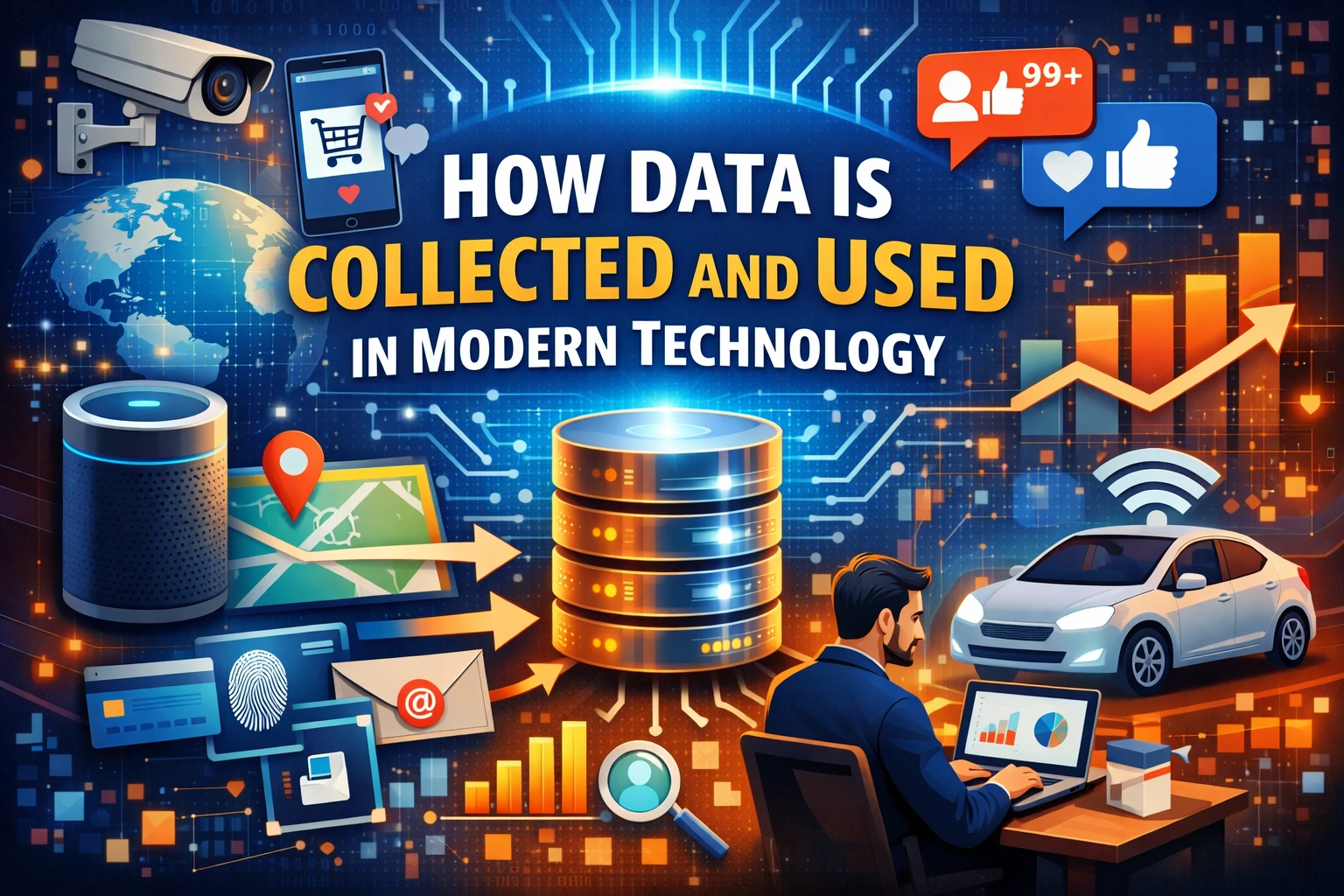
Every time someone searches online, opens a mobile app, or interacts with a connected device, data is generated. This process has become one of the defining characteristics of modern digital infrastructure. For businesses, data collection enables smarter decisions, personalized services, and operational efficiency. For individuals, it raises questions about privacy, consent, and control.
This guide explains how data is collected and used across common technology platforms in plain, accurate terms. It is written for business professionals evaluating AI and SaaS tools, as well as beginners who want to understand what happens to their information in digital environments.
Whether you are managing a team’s SaaS stack, building a product, or simply curious about how platforms handle user data, this article provides a practical framework for understanding the data lifecycle.
Part 1: How Data Is Collected
Passive vs. Active Data Collection
Data collection in modern technology happens through two primary mechanisms: passive and active.
Passive collection occurs without direct user input:
- Browser cookies and session tracking
- Device fingerprinting (screen size, OS, browser version)
- IP address logging
- Behavioral analytics (scroll depth, click patterns, time on page)
- Location data via GPS or network triangulation
- IoT sensor readings (smart devices, wearables)
Active collection occurs when users voluntarily provide data:
- Account registration forms
- Survey and feedback submissions
- File uploads and document sharing
- User-generated content (messages, posts, reviews)
- API integrations authorized by the user
Both types often run simultaneously on modern platforms. A user filling out a contact form (active) on a website is also being tracked for session behavior (passive) at the same time.
Common Data Collection Methods in SaaS and AI Platforms
Modern AI tools and SaaS platforms use several technical approaches to gather data:
- Tracking pixels: Small embedded images that register when a page or email is opened
- First-party cookies: Set by the website the user is visiting, used for session management and preferences
- Third-party cookies: Set by external services (e.g., ad networks or analytics providers), used for cross-site tracking
- SDKs and APIs: Software development kits embedded in apps to collect usage telemetry
- Server-side logging: Backend systems that record all requests, errors, and user events
- Form analytics: Tools that observe how users interact with input fields
Part 2: Types of Data Collected
Personal vs. Non-Personal Data
Not all data is the same. Understanding the distinctions is important for compliance, privacy policy evaluation, and vendor assessment.
| Data Type | Examples | Typical Use |
|---|---|---|
| Personal Identifiable Information (PII) | Name, email, phone, IP address | Account management, communication |
| Behavioral Data | Clicks, sessions, search history | UX improvement, personalization |
| Transactional Data | Purchase history, invoices | Billing, fraud detection |
| Device/Technical Data | OS version, browser, screen size | Bug tracking, compatibility |
| Location Data | GPS coordinates, city-level | Localization, logistics |
| Inferred Data | Credit score estimate, interest prediction | Advertising, recommendations |
| Aggregated/Anonymized Data | Usage trends, feature popularity stats | Product analytics, research |
Metadata: The Often Overlooked Layer
Beyond content, platforms collect metadata — data about data. When a file is uploaded to a cloud platform, the platform records not just the file content but also its name, size, creation date, author, and edit history. Metadata is rarely visible to users but is frequently used in AI model training, search indexing, and security auditing.
Part 3: How Collected Data Is Used
Business and Product Applications
Once data is collected, organizations use it across multiple functions:
- Product improvement: Usage logs help identify features that are underused or cause errors
- Personalization: Behavioral data enables adaptive interfaces, recommendation engines, and custom dashboards
- Security and fraud detection: Anomaly detection systems flag unusual access patterns
- Performance monitoring: Server logs and uptime metrics drive infrastructure decisions
- Customer support: Interaction history gives support teams context for resolving issues faster
- Marketing and targeting: Demographic and behavioral data are used to segment audiences and optimize campaigns
AI Model Training
One of the most significant uses of data in 2026 is training machine learning and AI models. Platforms that collect interaction data — such as queries, corrections, and feedback — often use this data to improve their models over time.
This process is typically governed by terms of service agreements, but the extent to which user data contributes to model training varies widely by vendor. Enterprise SaaS contracts frequently include data processing addenda (DPAs) that specify whether customer data is used for model training.
Key questions to ask any AI vendor:
- Is my data used to train your models?
- Is training data anonymized or aggregated before use?
- Can I opt out of contributing to model training?
- How long is my data retained?
Third-Party Data Sharing
Collected data often moves beyond the original platform. Common third-party sharing scenarios include:
- Analytics providers (e.g., usage statistics shared with BI platforms)
- Advertising networks (behavioral data used for ad targeting)
- Cloud infrastructure providers (data stored on third-party servers)
- Compliance and legal requirements (data disclosed to regulatory bodies upon request)
- Data brokers (aggregated data sold to external buyers — less common in enterprise contexts but prevalent in consumer apps)
The degree of control users have over this sharing depends on applicable data protection law and the platform’s privacy settings.
Part 4: Data Governance and Regulation
Global Regulatory Landscape
Data collection is not unregulated. Several major frameworks govern how organizations collect, store, and use data depending on geography and industry:
- GDPR (EU): Requires lawful basis for processing, user consent for non-essential cookies, right to erasure, and data portability
- CCPA/CPRA (California): Grants consumers the right to know what data is collected, opt out of sale, and request deletion
- PDPA (South Korea, Thailand): Regional frameworks with similar consent and transparency requirements
- HIPAA (US Healthcare): Governs health data with strict limits on collection and disclosure
- ISO/IEC 27001: International information security standard used by enterprise SaaS vendors
What Compliance Means in Practice
For businesses evaluating tools, compliance is not just a legal checkbox. It affects:
- How vendors store and encrypt data
- Whether data can be transferred across national borders
- What audit trails exist for data access
- How quickly a vendor can respond to a data subject access request (DSAR)
Part 5: Decision Framework — Evaluating How a Platform Uses Your Data
Before adopting an AI tool or SaaS platform, use the following checklist to assess data practices:
1. Review the Privacy Policy
- Does it clearly state what data is collected?
- Is the language plain enough to understand?
- Is there a version history or last-updated date?
2. Assess the Data Processing Agreement (DPA)
- Is a DPA available for enterprise customers?
- Does the DPA address model training?
- Is sub-processor disclosure included?
3. Check Data Residency Options
- Can data be stored in a specific geographic region?
- Does the vendor comply with local data sovereignty laws?
4. Evaluate User Controls
- Can users export their data?
- Can users delete their accounts and associated data?
- Are there role-based access controls for team environments?
5. Verify Security Certifications
- SOC 2 Type II
- ISO/IEC 27001
- CSA STAR
Comparison: How Different Platform Types Handle Data Collection
| Platform Type | Primary Data Collected | Common Uses | User Control Level |
|---|---|---|---|
| Search Engines | Queries, click patterns, location | Personalization, ad targeting | Medium (opt-out options) |
| SaaS Productivity Tools | Documents, activity logs, metadata | Feature improvement, support | Medium–High (DPAs available) |
| AI Assistants | Prompts, feedback, conversations | Model training, quality | Variable (depends on vendor) |
| E-commerce Platforms | Purchase history, browsing, payments | Recommendations, fraud detection | Medium |
| IoT Devices | Sensor data, usage patterns, location | Automation, analytics | Low–Medium |
| Mobile Apps | Device info, location, usage time | Advertising, engagement metrics | Low (depends on permissions) |
Frequently Asked Questions
1. Can I prevent websites from collecting my data?
Partially. Browser privacy settings, ad blockers, and VPNs reduce tracking but do not eliminate it. Essential data collection (e.g., session management) is required for websites to function. Regulations like GDPR require consent for non-essential cookies, giving users more control in jurisdictions where such laws apply.
2. Does using a paid SaaS tool mean my data is not used for advertising?
Generally, yes. Enterprise SaaS platforms typically do not use customer data for advertising. However, the platform may still collect usage telemetry for product analytics. Always review the DPA and privacy policy to confirm.
3. What is the difference between anonymized and pseudonymized data?
Anonymized data has been processed so that individuals cannot be re-identified under any reasonable circumstances. Pseudonymized data replaces direct identifiers with codes but can potentially be reversed with additional information. Under GDPR, only fully anonymized data falls outside the regulation’s scope.
4. How long do platforms typically retain user data?
Retention periods vary widely. Some platforms retain data for the duration of an account plus a grace period (e.g., 30–90 days after deletion). Others retain aggregated data indefinitely for analytics purposes. Enterprise contracts often include negotiated retention terms.
5. What should I do if I suspect a vendor has misused my data?
Start by reviewing the platform’s privacy policy and DPA. Contact the vendor’s data protection officer (DPO) if one is listed. In regulated jurisdictions, you can file a complaint with the relevant supervisory authority (e.g., a national data protection authority under GDPR).
Summary
Data collection is embedded in nearly every layer of modern technology — from the apps used daily to the AI tools reshaping business workflows. Understanding how data is collected, what it is used for, and what rights exist around it is no longer optional knowledge for technology users and decision-makers.
Key takeaways from this guide:
- Both passive and active collection methods are used simultaneously on most platforms
- Data serves a wide range of purposes: product analytics, AI training, personalization, and compliance
- Regulatory frameworks like GDPR, CCPA, and PDPA set minimum standards for data protection
- Businesses should evaluate vendor data practices using structured criteria before adoption
- User control levels vary significantly by platform type and contract terms
The landscape continues to evolve as AI becomes more deeply integrated into enterprise software. Staying informed about data practices is a foundational skill for anyone working with modern technology.