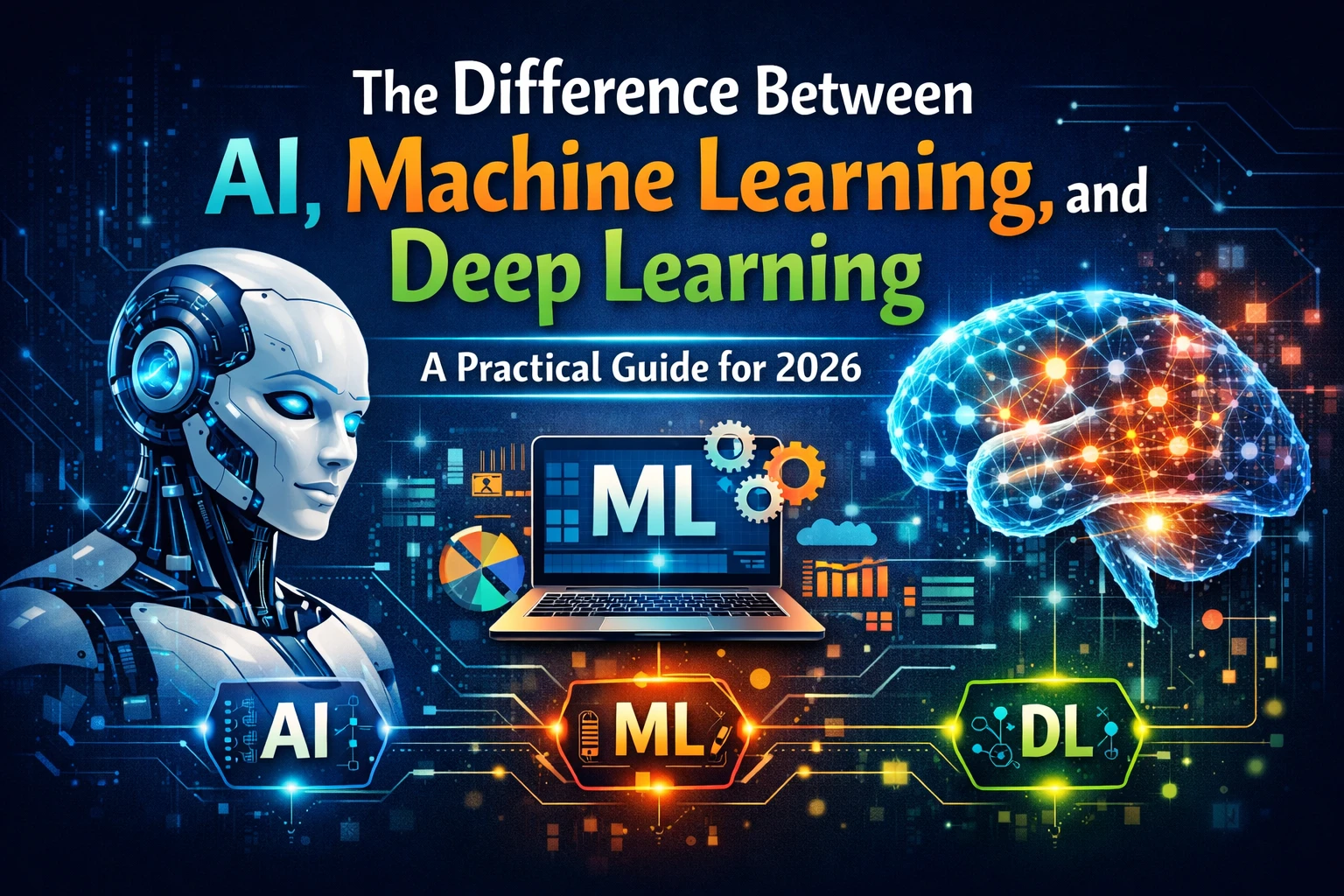
In 2026, AI-related terminology appears in nearly every business conversation, product pitch, and technology headline. Yet despite how frequently the terms artificial intelligence, machine learning, and deep learning are used, they are routinely treated as interchangeable — which they are not.
This distinction is not just academic. For business professionals evaluating SaaS platforms, for product managers selecting AI-powered tools, and for beginners trying to understand what these systems actually do, confusing these terms leads to poor decisions, misaligned expectations, and wasted resources.
This guide explains each concept clearly, explores how they relate to one another, and provides a practical framework for identifying which type of system you are actually working with.
What Is Artificial Intelligence?
Artificial intelligence is the broadest of the three terms. It refers to any computational system designed to perform tasks that would typically require human-level reasoning, judgment, or perception. AI is a field of computer science, not a single technology or method.
Early AI systems, developed in the 1950s and 1960s, operated through explicit rule sets written by programmers. These are often called rule-based systems or expert systems. A chess program that evaluates every possible move according to predefined logic is an example of classical AI — it appears intelligent, but its behavior is entirely determined by human-written instructions.
What AI Covers as a Category
- Rule-based reasoning and decision trees
- Natural language processing (NLP)
- Computer vision and image recognition
- Robotic process automation with adaptive logic
- Machine learning and deep learning (as subfields)
- Reinforcement learning and planning systems
The key characteristic of any AI system is that it produces outputs resembling intelligent behavior — regardless of the method used to achieve that output.
What Is Machine Learning?
Machine learning is a subset of AI. Rather than programming a system with explicit rules, machine learning allows a system to learn patterns from data and improve its performance over time without being explicitly told what to do.
The foundational idea, formalized in the 1980s and 1990s, is that a model can be trained on labeled examples and then generalize to new, unseen examples. A spam filter trained on thousands of spam and non-spam emails learns to classify future emails — not because it was told “if the subject contains this word, mark as spam,” but because it identified statistical patterns across the training data.
Core Types of Machine Learning
- Supervised learning: The model trains on labeled input-output pairs (e.g., predicting house prices from historical sales data)
- Unsupervised learning: The model finds structure in unlabeled data (e.g., customer segmentation)
- Reinforcement learning: The model learns by receiving feedback signals for actions taken in an environment (e.g., game-playing agents)
- Semi-supervised learning: A combination of labeled and unlabeled data, commonly used when labeling is expensive
Machine learning algorithms include logistic regression, decision trees, random forests, support vector machines, and gradient boosting methods. These are well-established approaches that remain widely used in production systems across industries.
Machine learning works well when the relationship between inputs and outputs can be captured through statistical patterns, and when clean, structured training data is available.
What Is Deep Learning?
Deep learning is a subset of machine learning. It uses artificial neural networks with many layers — hence “deep” — to learn representations of data at increasing levels of abstraction.
While conventional machine learning often requires human experts to select and engineer the features the model should learn from (a process called feature engineering), deep learning models can learn relevant features directly from raw data. This makes them especially effective for tasks involving images, audio, and text.
What Makes Deep Learning Different
- Requires significantly more data to train effectively
- Computationally expensive — relies on GPUs or specialized hardware
- Capable of learning from unstructured data (images, audio, raw text)
- Less interpretable than classical ML models (“black box” concern)
- Powers large language models (LLMs), image generators, and voice recognition systems
Modern applications of deep learning include real-time translation, facial recognition, medical image analysis, and the large language models now embedded in many SaaS products.
How They Relate: A Nested Model
The simplest way to understand the relationship is through nesting:
- AI is the broadest category — any system simulating intelligent behavior
- Machine learning is a subset of AI — systems that learn from data
- Deep learning is a subset of machine learning — systems using multi-layered neural networks
Not every AI system uses machine learning. Not every machine learning system uses deep learning. Understanding this hierarchy prevents common misreadings of product claims and technical documentation.
Comparison Table: AI vs. Machine Learning vs. Deep Learning
| Characteristic | Artificial Intelligence | Machine Learning | Deep Learning |
|---|---|---|---|
| Scope | Broadest — entire field | Subset of AI | Subset of ML |
| Core method | Rules, logic, or learning | Statistical learning from data | Multi-layer neural networks |
| Data requirement | Varies (rules may need none) | Moderate structured data | Large volumes of data |
| Feature engineering | Manual (rule-based) | Often required | Largely automated |
| Interpretability | High (for rule-based systems) | Moderate | Low (black box) |
| Hardware demand | Low to moderate | Moderate | High (GPU/TPU required) |
| Common applications | Chatbots, automation, expert systems | Fraud detection, recommendations, forecasting | Image recognition, LLMs, voice AI |
| Typical training time | None to days | Minutes to days | Days to weeks |
Real-World Examples Across Industries
Finance
- AI (rule-based): A flagging system that blocks transactions above a set threshold
- Machine learning: A fraud detection model trained on millions of labeled transactions
- Deep learning: A document analysis system that extracts data from scanned contracts
Healthcare
- AI: A triage chatbot using decision trees to assess symptoms
- Machine learning: A readmission risk predictor using structured patient records
- Deep learning: A radiology tool that identifies anomalies in MRI scans
Retail and E-Commerce
- AI: An inventory reorder system following deterministic business rules
- Machine learning: A recommendation engine based on purchase history patterns
- Deep learning: A visual search tool that matches product images to catalog items
Common Misconceptions Worth Addressing
“All AI is machine learning”
This is false. Many production AI systems are entirely rule-based — particularly in regulated industries where explainability is required. A system does not need to learn from data to qualify as AI.
“Deep learning is always better than classical ML”
Also false. For tabular, structured data with limited volume, gradient boosting methods (such as XGBoost or LightGBM) frequently outperform deep learning approaches, with significantly lower computational cost and greater interpretability.
“If a product says ‘AI-powered,’ it uses deep learning”
Not necessarily. Many products marketed as AI use simple rule sets, basic statistical models, or lightweight machine learning models. The term “AI-powered” has become a broad marketing descriptor that does not specify which underlying method is in use.
Decision Framework: Which Category Applies to Your Use Case?
When evaluating an AI tool or system for your business, these questions help clarify what you are actually working with:
- Does the system learn from new data over time? If no, it is likely rule-based AI. If yes, it is likely machine learning or deep learning.
- What type of data does it process? Unstructured data (images, audio, raw text) suggests deep learning. Structured tabular data suggests classical machine learning.
- Can the system explain its decisions? High interpretability suggests rule-based or classical ML. Low interpretability suggests deep learning.
- How much data does it require? Small datasets → classical ML. Large datasets → deep learning.
- What are the compute requirements? GPU-intensive infrastructure signals deep learning at the core.
Why This Matters for SaaS Buyers and Business Teams
For organizations evaluating AI-powered SaaS products, understanding these distinctions has practical implications. A customer service platform that classifies tickets using keyword matching operates differently from one that uses a fine-tuned large language model — and those differences affect accuracy, cost, maintenance requirements, and failure modes.
Similarly, when internal teams discuss building AI capabilities, the choice between machine learning and deep learning affects required data infrastructure, talent acquisition, timelines, and interpretability obligations — particularly in compliance-sensitive environments.
Neither machine learning nor deep learning is inherently superior. The appropriate choice depends on the data available, the complexity of the task, interpretability requirements, and operational constraints.
Summary
Artificial intelligence, machine learning, and deep learning are not synonyms — they describe a nested hierarchy of technologies with distinct methods, capabilities, and trade-offs.
- AI is the umbrella term for systems exhibiting intelligent behavior, whether rule-based or data-driven
- Machine learning is a data-driven subset of AI where models improve through experience
- Deep learning is a subset of machine learning using multi-layered neural networks for complex, unstructured data tasks
Understanding these distinctions allows business professionals and technical evaluators to ask better questions, set realistic expectations, and make more informed decisions when working with or investing in AI systems.
Frequently Asked Questions
1. Is deep learning the most advanced form of AI?
Deep learning is among the most capable approaches for specific tasks — particularly those involving unstructured data like images and text. However, it is not universally superior. For structured data problems or tasks requiring clear decision logic, classical machine learning or rule-based systems often perform better with less complexity and cost.
2. Can a business use AI without machine learning?
Yes. Many effective business AI systems operate on rule-based logic — automated eligibility checks, decision trees, or expert systems. These do not require training data and can be highly effective for well-defined, predictable problems.
3. What is a large language model (LLM) and where does it fit?
Large language models are deep learning systems trained on massive text corpora. They fall within the deep learning category and represent a specific application of neural network technology. LLMs are the foundation of many conversational AI products and text generation tools now embedded in SaaS platforms.
4. How do I know which type of AI a SaaS tool uses?
Look at vendor documentation, technical whitepapers, or ask directly during evaluation. Questions about training data, model update frequency, explainability, and compute infrastructure typically reveal the underlying approach. Generic marketing language alone is not a reliable indicator.
5. Is machine learning difficult to implement without a data science team?
It depends on the task. AutoML platforms have lowered the barrier significantly, allowing teams with limited data science expertise to build and deploy basic ML models. However, production-grade machine learning systems — especially those requiring custom data pipelines, ongoing monitoring, and bias evaluation — still benefit substantially from technical expertise.