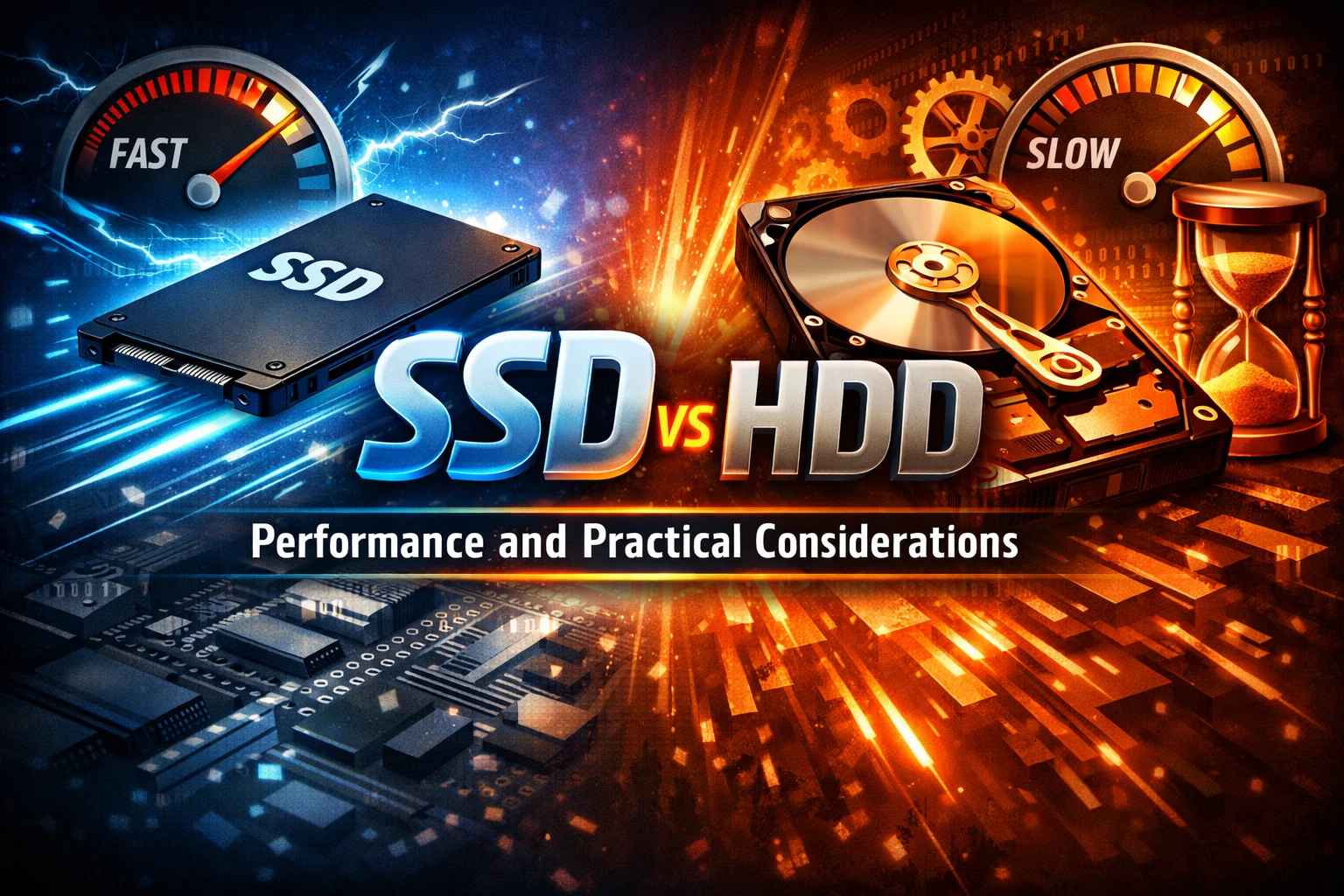
Introduction: Why Storage Still Matters in 2026
Storage is often overlooked when evaluating computer performance. Most discussions focus on CPUs, RAM, or graphics cards — yet the type of storage drive in a system has a direct, measurable impact on how fast software loads, how reliably data is maintained, and how efficiently a business operates at scale.
In 2026, the gap between Solid State Drives (SSDs) and Hard Disk Drives (HDDs) has widened considerably. SSDs have dropped in price, enterprise adoption has accelerated, and HDDs retain a firm role in specific use cases. Despite this, many individuals and organizations still make storage decisions based on outdated assumptions.
This guide is for business professionals, IT decision-makers, small business owners, and general users who want a clear, unbiased understanding of when to choose SSD, when HDD still makes sense, and how each technology performs under real-world conditions.
What Are SSDs and HDDs?
How SSDs Work
A Solid State Drive stores data on NAND flash memory chips — the same category of technology used in USB drives and smartphones. Because there are no moving parts, data can be accessed almost instantaneously. SSDs communicate with the system either through the older SATA interface or the faster NVMe (Non-Volatile Memory Express) protocol over PCIe lanes.
Key characteristics of SSDs:
- No mechanical components
- Access times measured in microseconds
- Silent operation
- Lower susceptibility to physical shock
- Available in M.2, 2.5-inch, and PCIe card form factors
How HDDs Work
A Hard Disk Drive stores data magnetically on spinning platters. A mechanical arm reads and writes data as the platters rotate, typically at 5,400 or 7,200 RPM for consumer drives and up to 15,000 RPM for enterprise models. This mechanical nature introduces latency and physical vulnerability.
Key characteristics of HDDs:
- Mechanical read/write heads
- Rotational latency adds to access time
- Audible during operation
- Vulnerable to impact while active
- Available in 3.5-inch (desktop) and 2.5-inch (laptop) form factors
Performance Comparison: Where the Gap Is Most Visible
Sequential Read and Write Speeds
Sequential speed refers to how fast a drive can read or write large, contiguous files — such as video exports, database backups, or OS image files.
| Metric | HDD (7,200 RPM) | SATA SSD | NVMe SSD |
|---|---|---|---|
| Sequential Read | 80–160 MB/s | 500–560 MB/s | 3,000–7,000 MB/s |
| Sequential Write | 80–150 MB/s | 450–530 MB/s | 2,500–6,500 MB/s |
| Random Read (IOPS) | 75–150 | 50,000–100,000 | 300,000–1,000,000+ |
| Access Time | 5–10 ms | 0.1 ms | 0.02–0.05 ms |
| Noise Level | Audible | Silent | Silent |
| Shock Resistance | Low | High | High |
| Typical Lifespan | 3–5 years | 5–10 years | 5–10 years |
Random Access Performance
Random read/write performance — measured in IOPS (Input/Output Operations Per Second) — is often more relevant to everyday computing than sequential speeds. When an operating system boots, when a database queries records, or when multiple applications run simultaneously, the drive handles thousands of small, scattered read requests.
This is where SSDs hold a decisive advantage. An HDD’s mechanical arm must physically reposition between each operation, introducing latency at every step. An SSD accesses any location on the chip at the same speed, regardless of where data was last written.
For workloads involving:
- Operating system boot and application launch
- Database transactions
- Virtual machine operation
- Multi-tab browser sessions
- Running SaaS development environments locally
…the SSD advantage translates directly into productivity.
(External Reference: https://www.backblaze.com/blog/hard-drive-stats/)
Durability and Reliability
SSD Endurance
SSDs use a metric called TBW (Terabytes Written) to indicate rated endurance. A consumer-grade SSD might be rated for 150–600 TBW, while enterprise-grade drives reach several thousand TBW. Modern SSDs also use wear-leveling algorithms to distribute writes evenly across cells, extending practical lifespan.
Notable reliability factors for SSDs:
- No moving parts means lower failure rate from physical impact
- Performance can degrade near full capacity
- Silent failure modes — some SSDs fail without warning signs
- Data retention concerns in unpowered storage (though rarely an issue in active use)
HDD Endurance
HDDs can fail mechanically — the read/write head can crash into the platter under impact, or bearings can wear out over time. However, HDDs often show gradual performance degradation before complete failure, making early detection more predictable with SMART monitoring tools.
Notable reliability factors for HDDs:
- Higher susceptibility to shock and vibration
- Well-understood failure patterns
- Generally no write-cycle limitations
- Backblaze’s long-term reliability studies suggest annual failure rates between 1–5% depending on model and age
For archival or backup purposes where drives are stored powered-off for extended periods, HDDs have historically been more reliable for long-term data retention.
Use Cases: Practical Decision Framework
When SSD Is the Better Choice
SSDs are appropriate in the following scenarios:
- Primary system drive: Any machine used for active work benefits from an SSD as the boot drive. The improvement in OS responsiveness and application load time is immediate and significant.
- Laptop and mobile use: SSDs are more resilient to movement and impact, making them safer in portable devices.
- Development environments: Compiling code, running containers, and handling version control all benefit from fast random I/O.
- Video editing and media production: NVMe SSDs support high-bitrate file workflows without bottlenecking render pipelines.
- Database servers with frequent queries: High IOPS reduces query latency in OLTP workloads.
When HDD Remains Viable
HDDs continue to serve legitimate roles in specific contexts:
- High-capacity archival storage: Cost-per-gigabyte for HDDs remains significantly lower. For cold storage — data accessed rarely — the performance difference is irrelevant.
- NAS (Network Attached Storage) systems: HDDs rated for NAS use (such as Western Digital Red or Seagate IronWolf) are optimized for continuous operation in RAID arrays.
- Bulk media libraries: Storing large video libraries, raw photo archives, or backup repositories where capacity matters more than speed.
- Secondary drives in hybrid setups: Pairing an SSD system drive with an HDD data drive is a cost-effective approach for many desktop users.
- Budget-constrained environments: In organizations managing hundreds of machines, the cost difference per unit adds up.
(External Reference: https://www.crucial.com/articles/about-ssd/ssd-vs-hdd)
Cost Considerations
Price per Gigabyte in 2026
Consumer SSD prices have fallen substantially over the past decade. As of 2026, consumer SATA SSDs are available at roughly $0.05–$0.10 per gigabyte, while NVMe drives sit slightly higher. HDDs remain cheaper per gigabyte, particularly at high capacities — 4TB and 8TB drives often fall below $0.02–$0.04 per gigabyte.
Practical cost comparisons:
- A 1TB SATA SSD typically costs $50–$80
- A 1TB NVMe SSD typically costs $70–$120
- A 4TB HDD typically costs $70–$110
- A 4TB SSD costs significantly more — often $200–$350
The math is straightforward: if raw capacity per dollar is the primary metric, HDDs win at scale. If performance per dollar is the metric, SSDs are now competitive for primary drives.
Total Cost of Ownership
For business deployments, TCO extends beyond unit cost. Considerations include:
- Power consumption: SSDs consume less power, reducing electricity costs in server environments
- Cooling requirements: SSDs generate less heat, reducing cooling overhead
- Failure rate and replacement frequency: Lower mechanical failure rates in SSDs reduce IT maintenance burden
- Productivity impact: Faster drives reduce wait times, which has measurable impact on knowledge worker output
SSD and HDD in Business IT Environments
Enterprise Storage Architecture
Enterprise environments rarely rely on a single storage tier. Most modern server infrastructure uses tiered storage:
- Tier 0 / Hot storage: NVMe SSDs for databases and active workloads
- Tier 1 / Warm storage: SATA SSDs for frequently accessed files and application data
- Tier 2 / Cold storage: HDDs for backup, archival, and compliance data
This approach balances performance with cost efficiency. A business does not need every byte of data on NVMe — only the data that is actively queried or served.
Cloud and Hybrid Considerations
Major cloud platforms (AWS, Google Cloud, Azure) offer both SSD-backed and HDD-backed storage options. For cloud-hosted databases and application servers, SSD-backed instances — often listed as “gp3,” “SSD persistent disk,” or equivalent — carry a premium but deliver the IOPS required for production workloads.
For cloud backup storage and object storage (cold data), HDD-backed or tape-equivalent tiers are significantly cheaper.
If your organization is evaluating storage architecture for cloud migrations, understanding the SSD/HDD distinction helps in selecting appropriate instance and storage types rather than defaulting to the most expensive option. (Internal Link: https://clarivo.kr/)
Decision Framework: Which Should You Choose?
Use this simplified framework to guide your decision:
Step 1 — Define the workload type
- Active computing (OS, applications, databases) → SSD
- Bulk storage, backup, archival → HDD or hybrid
Step 2 — Assess capacity requirements
- Under 2TB primary storage → SSD is affordable
- Over 4TB with infrequent access → HDD remains cost-effective
Step 3 — Consider the device context
- Laptop or portable device → SSD (shock resistance, battery)
- Desktop or server with secondary storage → Hybrid approach
Step 4 — Evaluate budget constraints
- Performance-critical at any cost → NVMe SSD
- Cost-sensitive, moderate performance → SATA SSD
- Maximum capacity per dollar → HDD
Step 5 — Factor in failure tolerance
- Mission-critical data → SSD (primary) + HDD or cloud backup
- Non-critical bulk data → HDD with periodic backup
Summary
The SSD vs HDD question does not have a single correct answer — it depends on workload, capacity requirements, budget, and operational context.
SSDs offer clear performance advantages across almost every active computing scenario: faster boot times, lower application latency, better IOPS for databases, and greater durability in portable devices. As prices have declined, SSDs have become the practical default for primary drives in both consumer and business environments.
HDDs retain relevance in high-capacity storage roles where cost-per-gigabyte matters more than access speed. NAS systems, archival storage, backup repositories, and hybrid desktop configurations continue to benefit from HDD economics.
For most users in 2026, the optimal setup is an SSD system drive paired with HDD secondary storage where additional capacity is needed — combining the performance benefits of solid-state with the cost efficiency of magnetic storage.
Understanding both technologies allows for more deliberate infrastructure decisions rather than reflexive upgrades based on marketing language.
Frequently Asked Questions
Q1. Is an SSD always faster than an HDD? In nearly all practical use cases, yes. SSDs have faster sequential speeds, dramatically faster random access, and lower latency across the board. The only scenario where the speed difference is negligible is when reading very large files sequentially from a well-defragmented HDD, though even then, SSDs remain faster.
Q2. How long do SSDs last compared to HDDs? Both typically have a usable lifespan of 3–10 years under normal use. SSDs have no moving parts, reducing mechanical failure risk. However, SSDs degrade with write cycles (measured in TBW), while HDDs can develop bad sectors over time. Regular backups are necessary regardless of drive type.
Q3. Can I use both SSD and HDD in the same system? Yes. A common configuration is an SSD for the operating system and applications, and an HDD for bulk data storage (documents, media, backups). This approach is practical for desktop systems and entry-level servers where cost and capacity are both considerations.
Q4. Should businesses prioritize SSD for all workstations? For knowledge workers, the productivity impact of faster boot and application load times generally justifies the cost. However, organizations should evaluate actual workload requirements — a workstation used primarily for data entry has different storage needs than one running data analysis or software development tools.
Q5. Are HDDs becoming obsolete? Not in the near term. HDDs continue to dominate the high-capacity cold storage and archival market due to cost advantages. While SSDs are displacing HDDs in consumer laptops and enterprise primary storage, the total installed base of HDDs remains large, and the technology continues to advance with drives exceeding 20TB per unit.
Next read: Understanding Cloud Storage vs Local Storage for Business Use (Internal Link: https://clarivo.kr/)