The terms artificial intelligence, machine learning, and deep learning appear constantly in product announcements, job listings, and business strategy documents. Yet even professionals who work with these technologies daily often use them interchangeably — which leads to misaligned expectations, poor vendor evaluations, and budget decisions based on misunderstood capabilities.
In 2026, knowing the distinction between these three concepts is no longer optional for business professionals. Whether you are evaluating an AI-powered SaaS platform, managing a data team, or simply trying to make sense of what your technology vendors are selling you, a clear mental model of how these fields relate to one another will save you time and prevent costly mistakes.
This guide is written for business professionals, product managers, and technically curious beginners who want a factual, jargon-minimal explanation of how AI, machine learning, and deep learning differ — and when each term actually applies.
The Nested Relationship: Start Here
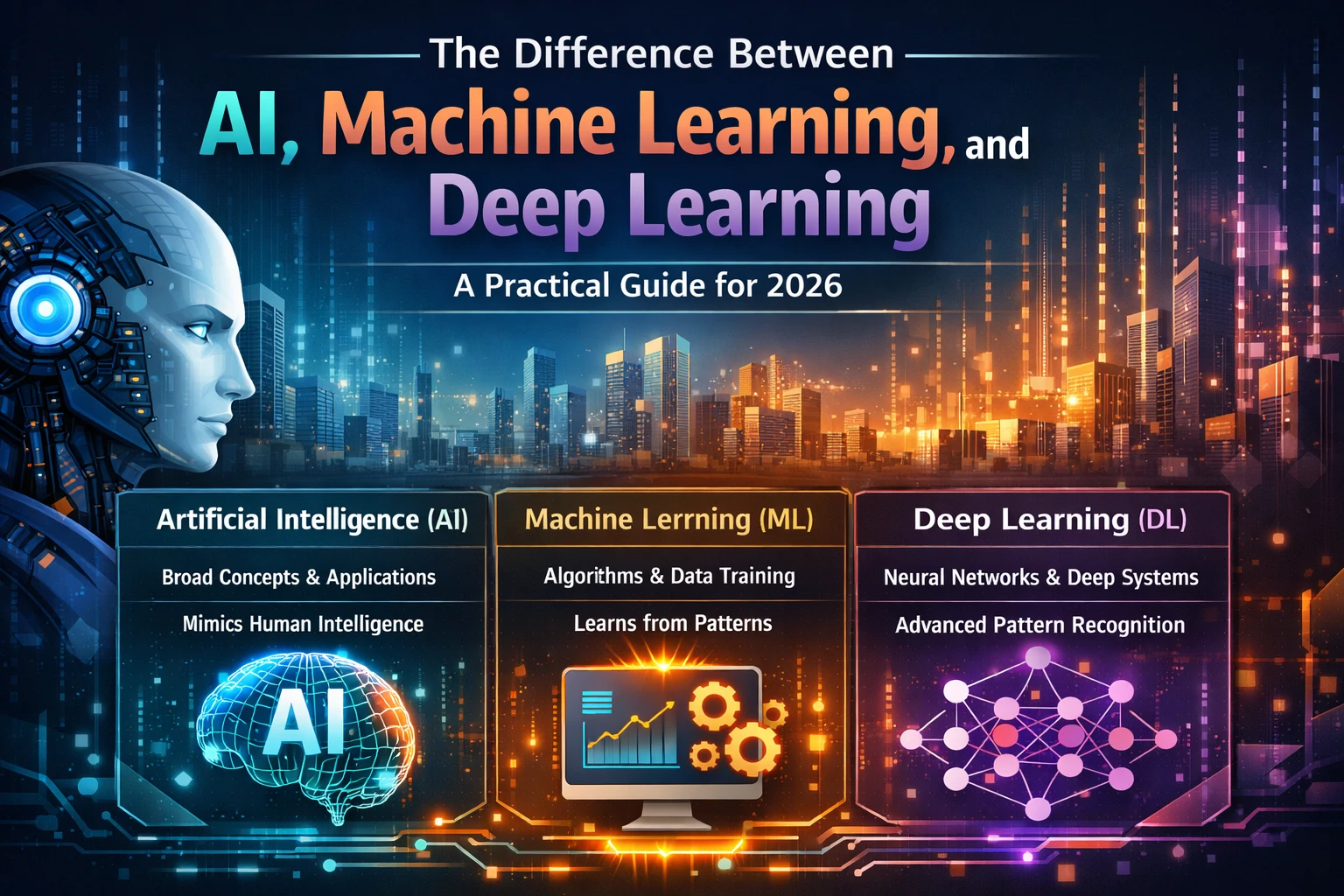
The most important thing to understand is that these three terms are not alternatives — they are nested disciplines. Think of them as concentric circles:
- Artificial Intelligence (AI) is the broadest field. It encompasses any technique that allows a machine to simulate intelligent behavior.
- Machine Learning (ML) is a subset of AI. It refers specifically to systems that learn patterns from data rather than following hard-coded rules.
- Deep Learning (DL) is a subset of ML. It uses layered neural networks to learn from large volumes of data, particularly unstructured data like images, audio, and text.
Every deep learning system is a machine learning system. Every machine learning system is a form of AI. The reverse is not true in either direction. Understanding this hierarchy prevents the most common source of confusion.
What Is Artificial Intelligence?
Artificial intelligence, as a field, dates back to the 1950s. Its original goal was to create machines capable of performing tasks that would require human intelligence if done manually — reasoning, planning, understanding language, recognizing objects, and making decisions.
Early AI systems worked primarily through rules. A programmer would define explicit logic: “if the customer has not logged in for 90 days, send a re-engagement email.” This approach, known as rule-based or symbolic AI, is still in active use today. Many business automation tools, decision trees, and customer service chatbots operate on this model.
Where Rule-Based AI Still Makes Sense
- Compliance and audit workflows that require full explainability
- Simple classification tasks with well-defined, stable criteria
- Low-data environments where training examples are unavailable
- Regulated industries requiring deterministic, auditable outputs
The limitation of rule-based AI is its brittleness. Rules must be written and maintained by humans. When conditions change, the rules must be updated manually. This is where machine learning introduced a fundamentally different approach.
(Internal Link: What Is Artificial Intelligence? A Beginner’s Overview)
What Is Machine Learning?
Machine learning shifts the programming paradigm. Instead of writing rules, a developer feeds data into an algorithm and lets the system derive its own rules. The system is said to “learn” because its outputs improve as it processes more examples.
There are three primary categories of machine learning:
Supervised Learning
The model trains on labeled data — inputs paired with known correct outputs. A credit risk model trained on historical loan applications and their outcomes (default or no default) is a common example. Once trained, the model predicts outcomes for new applications it has never seen.
Unsupervised Learning
The model receives data with no labels and identifies structure on its own. Customer segmentation tools that group users by behavioral patterns without predefined categories use this approach. The algorithm finds clusters; humans interpret what those clusters mean.
Reinforcement Learning
The model learns by interacting with an environment and receiving feedback signals (rewards or penalties). This approach is used in logistics optimization, robotics, and in the training of some large language models through a technique called reinforcement learning from human feedback (RLHF).
Machine learning requires clean, well-structured data and careful feature engineering — the process of selecting which variables the model should pay attention to. A data scientist typically manages this process manually. The quality of the model depends heavily on the quality of the features selected.
(External Reference: scikit-learn: Supervised Learning Documentation)
What Is Deep Learning?
Deep learning is a specific class of machine learning that uses artificial neural networks with many layers — hence “deep.” These networks are loosely inspired by how neurons connect in biological brains, though the analogy should not be taken literally.
What makes deep learning different from traditional ML is its ability to learn features automatically. A traditional ML model for image recognition might require a data scientist to manually extract features like edge sharpness, color histograms, or shape descriptors. A deep learning model processes raw pixel data and learns to identify relevant features on its own across multiple layers of abstraction.
Why Deep Learning Became Dominant After 2012
- Data availability: The internet produced vast amounts of labeled data (images, text, audio) that deep networks need to train effectively.
- Compute power: GPU processors made it economically feasible to train networks with hundreds of millions of parameters.
- Algorithmic improvements: Techniques like dropout, batch normalization, and improved activation functions addressed earlier training instability.
- Open-source frameworks: Libraries such as TensorFlow and PyTorch lowered the barrier to entry for research and production deployment.
Today, deep learning powers voice assistants, medical image analysis, real-time translation, fraud detection at scale, and the large language models behind generative AI tools.
(External Reference: LeCun, Bengio & Hinton — “Deep Learning” (Nature, 2015))
Comparison: AI vs. Machine Learning vs. Deep Learning
The table below summarizes how the three fields differ across key dimensions relevant to business and technical decision-making.
| Dimension | Artificial Intelligence | Machine Learning | Deep Learning |
|---|---|---|---|
| Scope | Broadest — all intelligent machine behavior | Subset of AI — data-driven learning | Subset of ML — neural network-based |
| Data Requirement | Varies — rules-based needs little data | Moderate structured data required | Large volumes, often unstructured |
| Feature Engineering | Manual (rule-based) | Partially manual | Automatic (learned by the network) |
| Interpretability | High (rule-based systems) | Moderate (depends on algorithm) | Low — often treated as a black box |
| Compute Needs | Low (rule-based) | Moderate | High — GPU/TPU often required |
| Typical Use Cases | Automation, decision trees, chatbots | Forecasting, classification, segmentation | Vision, NLP, speech, generative AI |
| Maintenance Burden | High — rules require manual updates | Moderate — retraining on new data | High — retraining expensive; drift monitoring required |
Real-World Use Cases by Category
Understanding where each approach is applied in practice helps clarify when the terminology actually matters for business decisions.
AI in Business Operations (Including Rule-Based Systems)
- ERP workflow automation triggered by rule conditions
- Email routing systems that classify support tickets by keyword patterns
- Chatbots operating on decision trees for FAQ resolution
- Compliance monitoring tools that flag transactions meeting defined criteria
Machine Learning in Analytics and Prediction
- Sales forecasting models trained on historical CRM data
- Churn prediction for SaaS platforms based on product usage signals
- Dynamic pricing engines in e-commerce and hospitality
- Anomaly detection for financial fraud using behavioral baselines
Deep Learning in Perception and Language
- Optical character recognition (OCR) for document digitization
- Medical imaging analysis for radiology support tools
- Real-time transcription and translation services
- Large language models used in content generation, search, and coding assistance
Decision Framework: Which Term Should You Use?
When evaluating tools or communicating with vendors, use this quick framework to apply the correct term:
Ask These Three Questions
- Does the system learn from data, or follow explicit rules? If rules only — it is AI, not ML. If it learns from data — it is ML at minimum.
- Does it process unstructured data (images, audio, free text) at scale? If yes — deep learning is likely involved.
- Is there a neural network with multiple hidden layers? If yes — it is deep learning, which is also ML and AI.
A vendor claiming their product uses “AI” without specifying whether it is rule-based or data-driven is leaving out information that directly affects how you should evaluate the product’s capabilities, maintenance requirements, and long-term scalability.
(Internal Link: How to Evaluate AI Tools for Your Business in 2026)
Common Misconceptions Worth Addressing
“AI means the system thinks like a human”
Current AI systems, including advanced deep learning models, do not reason or understand in the way humans do. They identify statistical patterns in data. The outputs can appear human-like, but the underlying mechanism is not general intelligence. The field studying machine systems with human-like generalization is called artificial general intelligence (AGI) and remains an active area of research, not a deployed commercial reality in 2026.
“More data always means a better deep learning model”
Data quality matters as much as quantity. A deep learning model trained on biased, mislabeled, or non-representative data will learn those biases and replicate them at scale. Data governance and curation are not optional steps in production ML systems.
“If it uses machine learning, it does not need human oversight”
ML and deep learning systems require ongoing monitoring for model drift — the degradation in performance that occurs when real-world data patterns change after training. A fraud detection model trained on 2023 transaction data may perform poorly by late 2025 if fraudsters have changed their methods. Monitoring, retraining pipelines, and human review loops are standard requirements for production systems.
Frequently Asked Questions
1. Is every AI product actually using machine learning?
No. Many products marketed as “AI-powered” use rule-based logic, decision trees, or simple automation scripts with no learning component. Asking vendors specifically whether their system adapts based on data — and how — will clarify what you are actually purchasing.
2. Can a small business use deep learning without a large data science team?
Increasingly, yes. Pre-trained models available through cloud APIs (for vision, language, and speech) allow businesses to access deep learning capabilities without training their own models. The data science expertise required for consuming these APIs is significantly lower than what is needed to build models from scratch.
3. What is the relationship between deep learning and generative AI?
Generative AI tools — including large language models and image generation systems — are built on deep learning architectures, primarily transformers. Generative AI is a category of application; deep learning is the underlying technique. Not all deep learning is generative, but most current generative AI relies on deep learning.
4. Why do machine learning models need to be retrained?
Models are trained on a snapshot of data from a specific time period. As real-world conditions change — user behavior, market dynamics, product catalogs, language use — the statistical patterns the model learned become less representative of current inputs. Retraining updates the model’s internal parameters to reflect current patterns. The frequency of retraining depends on how quickly the relevant data distribution changes.
5. Is deep learning always better than traditional machine learning?
Not always. Traditional ML algorithms such as gradient boosting or logistic regression often outperform deep learning on structured tabular data, especially when the dataset is small to medium-sized. Deep learning’s advantages become significant with large volumes of unstructured data — images, audio, long text — where manual feature engineering is impractical. The right choice depends on data type, data volume, interpretability requirements, and available compute resources.
Summary
Artificial intelligence is the broad discipline of making machines exhibit intelligent behavior. Machine learning is a data-driven approach within AI where systems learn from examples rather than explicit rules. Deep learning is a powerful subset of machine learning that uses multi-layered neural networks to process unstructured data at scale.
The three concepts are nested, not interchangeable. When evaluating technology, ask specifically which approach is in use, what data it requires, and how it is maintained. This prevents misaligned expectations and supports more informed procurement and strategy decisions.
As AI adoption in business accelerates through 2026, the ability to parse vendor claims accurately is a practical professional skill — not a technical luxury.
Next recommended read: (Internal Link: How Machine Learning Is Changing Business Analytics in 2026)